


Expanding a coffee product range from 250g retail packs to 500g and 1kg formats may seem like a straightforward packaging project. For coffee roasters and established brands, however, each additional size introduces another set of packaging specifications, artwork files, production requirements, and purchasing decisions.
Problems often become apparent when packaging from different orders is placed side by side. The black background on a 250g pouch may look slightly different from that on a 1kg bag. A larger pouch may not stand properly after filling, or its zipper position may interfere with the filling process.
These are not necessarily isolated manufacturing defects. They can also result from developing each packaging size independently without a common technical framework.
Standardizing custom coffee packaging means establishing shared specifications wherever possible while retaining the flexibility required for individual product sizes.
1. Define What Should and Should Not Be Standardized
Before selecting materials or preparing artwork, coffee brands should distinguish between shared packaging requirements and size-specific specifications.
|
Specifications to standardize |
Specifications to evaluate individually |
| Brand color references | Bag width and height |
| Surface finish | Gusset depth |
| Material family | Film thickness |
| Artwork design principles | Filling volume and headspace |
| Approved accessory specifications | Zipper length and position |
| Quality inspection methods | Mechanical performance requirements |
This distinction is important because standardization does not mean producing every coffee bag with identical specifications.
A 1kg coffee bag may require greater mechanical strength than a 250g pouch, even when both products use the same barrier material family and visual design.
The objective is to reduce unnecessary variation without compromising packaging performance.
2. Develop a Common Material and Barrier Specification
For roasted coffee beans and ground coffee, protection against oxygen and moisture is essential to maintaining product quality during storage and distribution.
Common structures for high barrier coffee packaging include PET/AL/PE and PET/VMPET/PE.
Aluminum foil laminates are often considered when high oxygen, moisture, and light barrier performance is required. Metallized film structures may offer an alternative depending on shelf-life targets, distribution conditions, and packaging budgets.
Where several coffee products have similar protection requirements, using a common laminate family can simplify material management and help maintain a consistent packaging appearance.
Film thickness, however, should be evaluated separately. Larger bags experience different loading conditions during filling, handling, and transportation.
Rather than specifying one thickness for every SKU, procurement teams should establish common barrier requirements and confirm the mechanical performance needed for each size.
3. Design Bag Dimensions Around the Coffee, Not Just the Weight
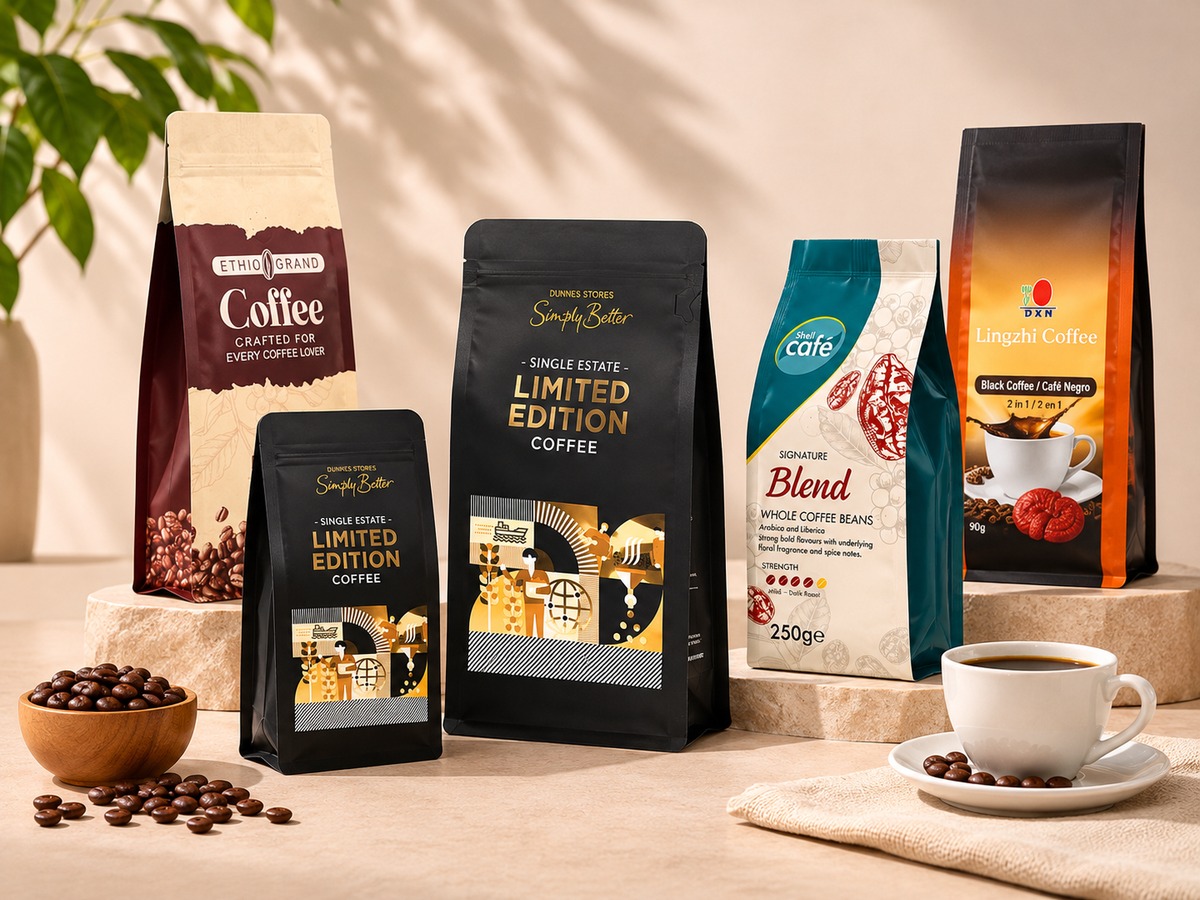
Coffee bag sizes cannot be determined accurately from filling weight alone.
Whole coffee beans and ground coffee have different bulk densities. Roast level, bean characteristics, and grinding size can also influence the volume occupied by the product.
Simply enlarging an existing 250g coffee bag to accommodate 500g or 1kg may result in excessive headspace, insufficient filling capacity, or an unstable finished pouch.
Packaging development should therefore consider:
- · Actual product bulk density and filling volume.
- · Bag width, height, and gusset depth.
- · Filling equipment and opening requirements.
- · Zipper, valve, and final sealing positions.
- · Finished appearance after filling.
Flat bottom coffee bags are often suitable for coordinated premium retail ranges, while side gusset bags and quad seal bags may be considered for larger commercial formats.
The final dimensions should be validated through filling trials using the actual coffee product.
4. Practical Case: Standardizing a Multi-Size Coffee Packaging Range
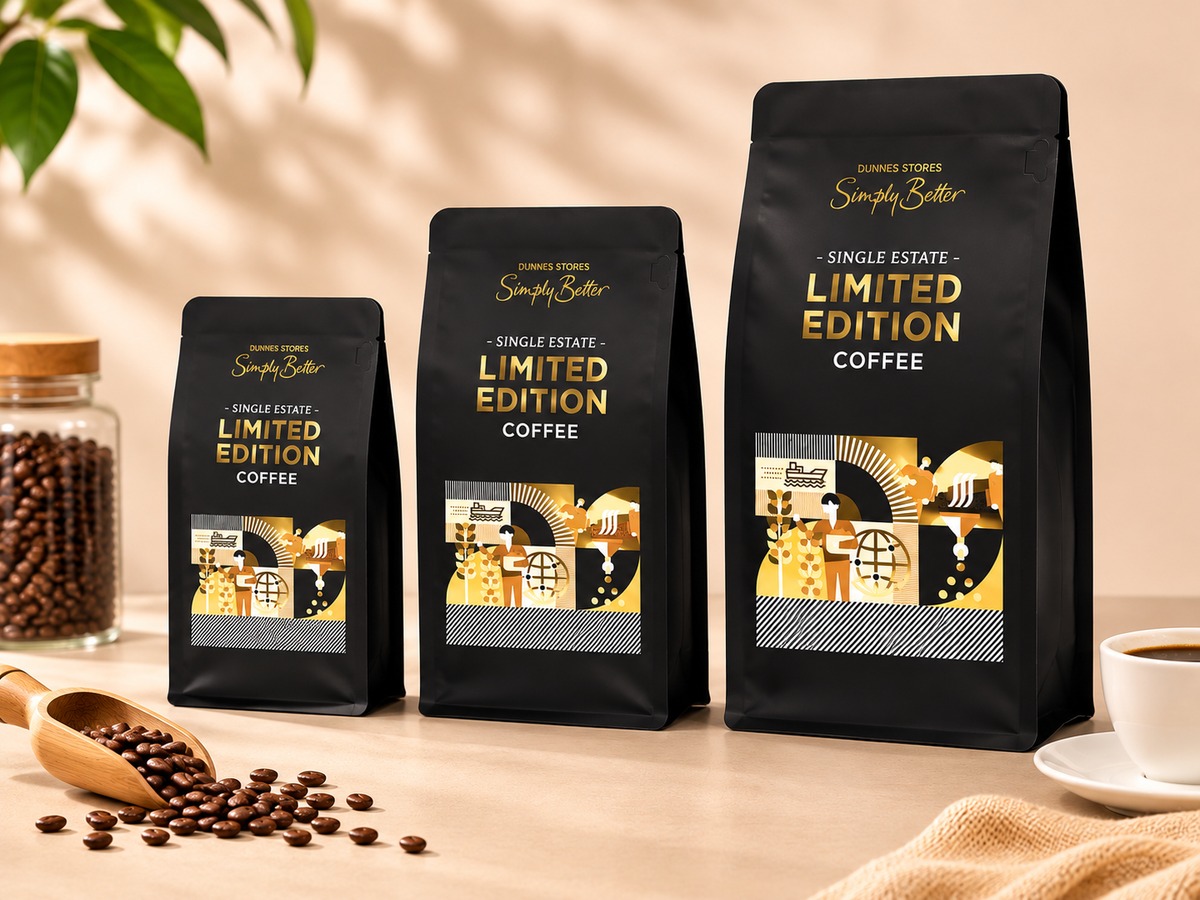
Consider a typical packaging development scenario involving a coffee roaster introducing 250g, 500g, and 1kg bags for the same roasted coffee range.
The brand wants all three formats to feature the same matte black appearance, gold graphics, high barrier protection, and resealable functionality.
At first, applying the existing 250g specifications to the larger bags appears to be the simplest approach. However, this creates several technical concerns.
The larger bag must accommodate a greater filling volume without placing excessive stress on the bottom and side seals. The original zipper position may also leave insufficient space for filling and final heat sealing.
Increasing the overall film thickness without evaluating the individual laminate layers could introduce unnecessary material costs or change pouch stiffness.
A more practical development approach would be to:
- · Retain the approved material family, matte finish, and brand color references.
- · Develop separate bag dimensions based on actual filling trials.
- · Evaluate film thickness and seal performance for each filling weight.
- · Use a common degassing valve specification where technically suitable.
- · Adjust zipper length and position to accommodate filling requirements.
- · Prepare individual artwork dielines using shared brand design rules.
Under this approach, the three formats belong to one coordinated packaging system without being forced into identical technical specifications.
This illustrative scenario demonstrates why packaging standardization should begin with engineering requirements rather than artwork resizing alone.
5. Control Printing and Functional Consistency During Production
Even with identical artwork color values, different printing substrates, ink applications, and lamination finishes can produce noticeable visual differences.
Coffee brands ordering custom printed coffee bags across multiple sizes should establish an approved physical color reference rather than relying exclusively on digital artwork.
Each SKU should have an individual dieline, with consistent rules for logo placement, typography, product information, and surface finish.
For recurring bulk orders, gravure printing is often a suitable production option. Digital printing may be considered for smaller runs or multiple artwork versions, subject to material compatibility.
Functional consistency also requires attention.
Coffee bags with degassing valves should be evaluated for valve performance and installation quality. Resealable zippers must remain compatible with the pouch dimensions and filling process.
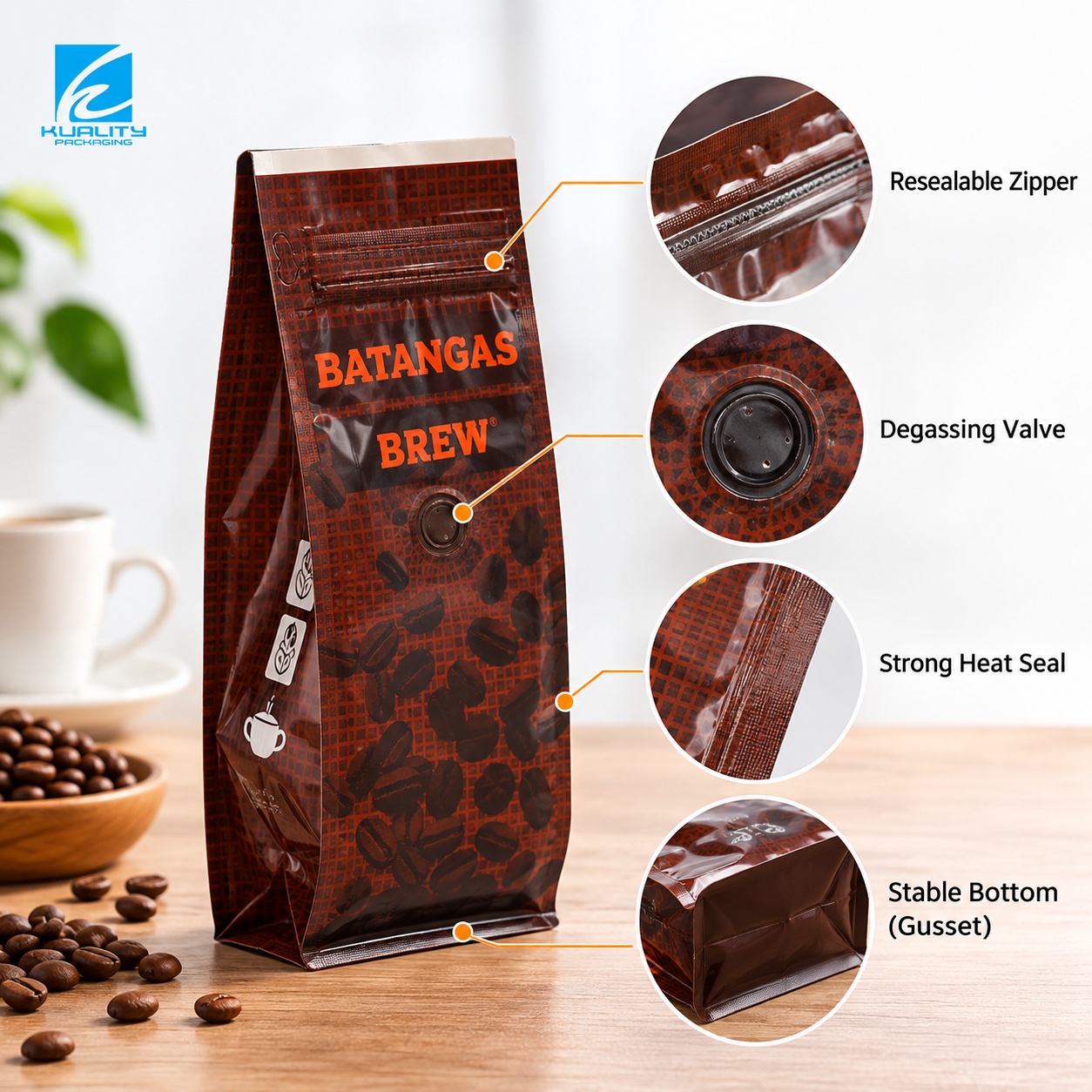
Quality inspection methods can be shared across the product range, while acceptance criteria for seal strength, dimensional tolerances, leakage, and handling performance should reflect the requirements of each format.
6. Standardize Procurement Without Overlooking Production Costs
Packaging standardization can also support purchasing and inventory management.
When coffee brands develop multiple sizes independently, they may introduce unnecessary material variations, accessory specifications, and artwork revisions.
Providing the packaging manufacturer with a complete SKU list allows production requirements to be evaluated together.
However, using the same material structure does not automatically mean that all sizes can share printing cylinders or minimum order quantities. Different bag dimensions, print repeats, and artwork layouts may require separate production arrangements.
Before placing a bulk order, procurement teams should confirm:
- · Annual demand and order quantities for each SKU.
- · Approved material and accessory specifications.
- · Printing cylinder and artwork requirements.
- · Minimum order quantities for individual formats.
- · Production schedules and repeat-order requirements.
This approach helps buyers assess total packaging procurement costs rather than focusing only on the unit price of each bag.
Build a Consistent Coffee Packaging System With Your Manufacturer
A standardized coffee packaging system should make future product launches and repeat orders easier to manage while maintaining the protection and functionality required by each product.
At HUIYANG PACKAGING, we manufacture custom coffee packaging bags for coffee roasters, coffee brands, manufacturers, and distributors. Our customization capabilities cover laminated material structures, bag dimensions, film thickness, printing, degassing valves, and resealable zippers.
If you are developing several coffee bag sizes or upgrading an existing product range, send us your complete SKU list, filling weights, artwork, packaging requirements, and estimated order quantities.
Contact our packaging team to discuss your coffee bag sizes, material requirements, artwork specifications, and estimated bulk order quantities.
Post time: Nov-24-2026