


Introduction: Why Does Printing Technology Matter in Flexible Packaging?
Choosing a printing method for flexible packaging is not just a question of print quality. It also affects setup costs, order flexibility, packaging lead times, and the cost per bag.
For brands ordering custom printed packaging bags or rollstock film, the right choice often depends on how many units they need, how frequently their artwork changes, and whether the product is still in the testing stage or ready for large-scale production.
Digital printing and rotogravure printing serve different production needs. Understanding their differences can help buyers select a printing method that fits both their current order and future production plans.
What is digital printing?
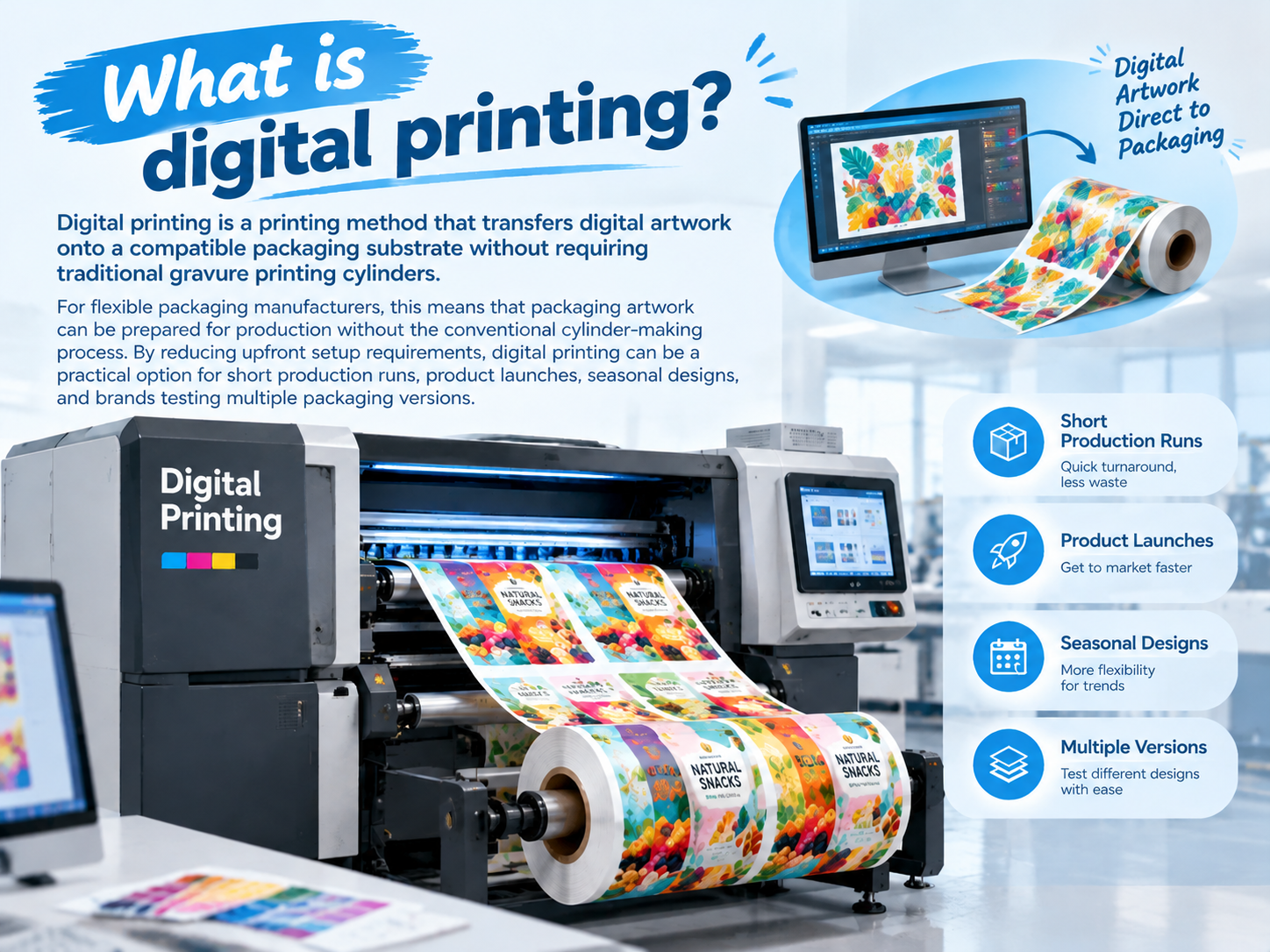
Digital printing is a printing method that transfers digital artwork onto a compatible packaging substrate without requiring traditional gravure printing cylinders.
For flexible packaging manufacturers, this means that packaging artwork can be prepared for production without the conventional cylinder-making process. By reducing upfront setup requirements, digital printing can be a practical option for short production runs, product launches, seasonal designs, and brands testing multiple packaging versions.
For example, a brand developing several new coffee bag designs may use digital printing to test different artwork versions before committing to larger production volumes. This approach can help reduce the initial investment in printing setup and avoid ordering large quantities before market demand becomes clear.
However, digital printing is not automatically the best option for every packaging project. Material compatibility, print requirements, available production capacity, and total order cost should all be considered before choosing a printing method.
Why are small-batch and flexible orders more suitable for digital printing?
For new brands or companies developing new products, market demand is usually still unstable.
Starting with mass production can lead to:
- Packaging inventory pressure
- Capital tied up
- Increased product testing risk
Digital printing eliminates the need for printing plates, avoiding additional plate-making costs. Furthermore, brands can adjust packaging designs, colors, text information, and even product versions at any time.
This allows brands to more easily:
- Test new products
- Launch multiple design versions
- Develop seasonal limited-edition packaging
- Reduce inventory risk
Is digital printing suitable for personalized packaging?
Yes.
The defining characteristic of digital printing is its high degree of customization.
Brands can quickly adapt packaging to market and product demands.
Examples include
- Limited edition packaging
- regionally available versions
- personalized gift wrapping
- holiday marketing packaging.
Because it eliminates the need to create new printing plates, design modifications can be made much faster, making it particularly suitable for brands that need to respond quickly to market changes.
For companies seeking brand differentiation, digital printing can help products achieve greater visual appeal on the shelf.
What is gravure printing? Why is it so widely used?
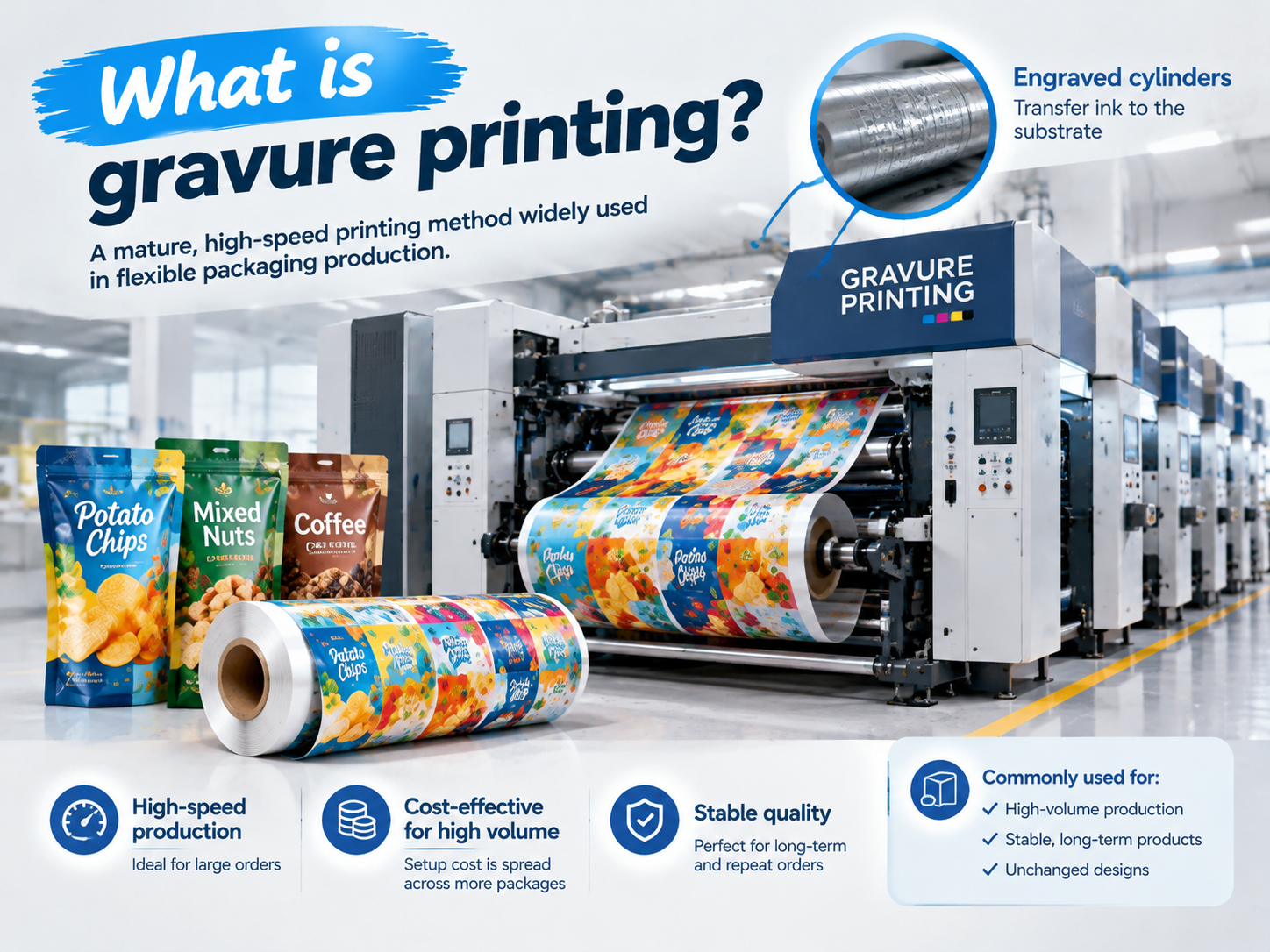
Rotogravure printing, also known as gravure printing, is a mature, high-speed printing method widely used in flexible packaging production.
It transfers ink from engraved printing cylinders onto the packaging substrate. Each design requires the preparation of printing cylinders, creating an upfront setup cost before mass production begins.
Although this initial investment can make gravure printing less economical for small orders, the cost can be spread across a larger number of packages as order volume increases. Combined with the high production efficiency of gravure printing equipment, this can make it a cost-effective option for large orders with stable packaging designs.
For flexible packaging buyers, the key consideration is not just the initial printing cost, but the total cost per package at the required order quantity.
Gravure printing is typically used for:
- High-volume flexible packaging production
- Products with stable, long-term sales
- Packaging designs that remain unchanged across repeat orders
- Custom printed packaging bags and rollstock film produced in large quantities
For packaging projects that require continuous production, explore our custom printed rollstock film solutions for automatic packaging applications.
Why do major brands prefer gravure printing?
The biggest advantages of gravure printing are its production efficiency and stability.
Large brands typically have huge order volumes, stable designs, and a strong pursuit of uniformity in color and quality.
Gravure printing has the following advantages:
- Stable printing colors
- Fast production speed
- Consistent quality in mass production
- More competitive pricing for large orders
What Are the Main Differences Between Digital Printing and Rotogravure Printing?
| Comparison factor | Digital Printing | Rotogravure Printing |
| Printing cylinders | No conventional gravure cylinders required | Engraved cylinders required |
| Initial setup cost | Typically lower | Typically higher |
| Short production runs | Often more economical | Setup cost may be harder to justify |
| Large production runs | May have a higher unit cos | Often more cost-effective |
| Artwork changes | Generally easier to accommodate | May require new or modified cylinders |
| Production Typical applications | Product testing, short runs, multiple designs | Large repeat orders, stable designs |
Custom printed packaging bags and rollstock film produced in large quantities.
Real-world Case Study: How Does a Coffee Brand Choose the Right Printing Method?
A North American specialty coffee brand planned to launch a premium coffee product line.
During the initial launch stage, the company needed to test different flavors and packaging designs. Since order quantities were limited, digital printing became the better choice. It allowed the brand to produce multiple designs quickly without plate costs, helping reduce inventory risks and test the market faster.
As one coffee flavor gained popularity and orders increased, the company switched to gravure printing for large-volume production. This helped lower the cost per package and improve long-term efficiency.
Meanwhile, digital printing continued to be used for new products and seasonal editions that required faster design changes and flexible production.
This case shows that digital printing and gravure printing are not competitors. Many successful brands use both methods based on different product stages and production needs.
If you are developing a coffee product line, explore our custom coffee packaging bags to learn more about available packaging formats and customization options.
How Should Brands Choose the Right Printing Method?
1.Order Quantity
If you require large-volume production, gravure printing is the preferred choice; for small batches, trial orders, and limited editions, digital printing is recommended.
2.Packaging Redesign Frequency:
If your brand frequently launches:
- New flavors,
- limited edition products,
- holiday packaging,
- multi-SKU products
then digital printing offers greater flexibility.
However, for established brands with consistently stable packaging designs, gravure printing is generally more suitable.
3.Product Development Stages
For new products just entering the market, digital printing can help brands reduce trial-and-error costs.
For mature products with stable sales, gravure printing can help companies improve production efficiency and reduce long-term costs.
4. Material Structure and Packaging Requirements
Printing decisions should also take the packaging material and final bag format into account. Flexible packaging may use laminated structures such as PET/PE, PET/MPET/PE, or PET/AL/PE, depending on the product’s barrier requirements and intended application.
Not every printing process or production line supports every material structure and bag format. Buyers should confirm material compatibility, print specifications, lamination requirements, and downstream pouch-making needs with their packaging supplier before placing an order.
For packaging used on automatic filling lines, it is also important to confirm that the final packaging format meets the equipment’s requirements.
Final Thoughts: Which Printing Method Is Better?
There is no single printing method that is perfect for every flexible packaging project.
Digital printing is ideal for brands that need flexibility, customization, and smaller production quantities.
Rotogravure printing is better suited for brands that require high-volume production, stable quality, and lower unit costs.
The best solution depends on your packaging goals, order quantity, product strategy, and future growth plans.
By selecting the right printing technology, brands can achieve better packaging performance while controlling production costs and improving market competitiveness.
Frequently Asked Questions About Flexible Packaging Printing
1. Is Digital Printing Cheaper Than Rotogravure Printing?
Digital printing can be more cost-effective for small production runs because it generally does not require traditional gravure printing cylinders. This reduces upfront setup costs, especially when a brand needs multiple artwork versions or is testing a new product.
Rotogravure printing typically requires a higher initial investment, but it can offer a lower unit cost for large production runs with stable designs. The most economical option depends on order quantity, material structure, bag size, printing requirements, and the supplier’s pricing.
2. What Is the Minimum Order Quantity for Rotogravure Printing?
There is no universal minimum order quantity for rotogravure printing. The required quantity varies by packaging manufacturer, printing equipment, material structure, bag format, and production specifications.
For custom printed flexible packaging bags, larger quantities are generally more suitable for gravure printing because the initial cylinder cost can be distributed across more units. Buyers should confirm the minimum order quantity with their supplier based on their specific packaging requirements.
3. Can Digital Printing Be Used for Laminated Flexible Packaging?
Digital printing can be used for certain laminated flexible packaging applications, provided that the printing technology, substrate, ink system, and subsequent lamination process are compatible.
However, not every digital printing process supports every packaging material or bag structure. Before placing an order, buyers should confirm material compatibility, print quality requirements, barrier properties, and suitability for the intended packaging application with their manufacturer.
4. Can I Change My Packaging Design After Printing Cylinders Have Been Made?
Yes, but changes to artwork may require modifications to or replacement of the relevant gravure printing cylinders, depending on the extent of the changes. This can result in additional setup costs and production preparation time.
For brands that frequently introduce new flavors, seasonal editions, or multiple product designs, digital printing may offer greater flexibility because it does not require conventional gravure printing cylinders. For established products with stable artwork and larger order quantities, gravure printing may be more economical over time.
Post time: Oct-09-2026