


As beverage brands expand their product lines and look for more flexible packaging formats, custom juice pouches have become an important option for commercial beverage production. Compared with traditional rigid containers, flexible juice packaging offers greater freedom in pouch design, printing, filling volume, and dispensing options.
However, developing successful juice pouch packaging requires more than choosing an attractive pouch shape. Beverage manufacturers must consider product characteristics, material structures, spout compatibility, filling conditions, sealing performance, and production-line requirements.
For commercial beverage brands, every specification must work together to ensure consistent packaging quality and reliable performance throughout transportation and storage.
This guide explains how to develop custom juice pouches, from initial product requirements to material selection, spout design, production testing, and bulk manufacturing.
1. Define Your Juice Product and Packaging Requirements
The first step in developing custom juice pouches is understanding the beverage itself and its processing conditions.
Different juice products have different packaging requirements. Fresh juice, fruit drinks, juice concentrates, smoothies, and beverages containing fruit pulp may require different barrier properties and dispensing designs.
Before selecting a packaging structure, beverage manufacturers should confirm:
Product type and formulation
Juice acidity and ingredient compatibility
Liquid viscosity and particle content
Required filling volume
Filling temperature and filling method
Expected shelf life
Storage and distribution conditions
For example, a clear fruit beverage may prioritize appearance and oxygen protection, while a fruit smoothie containing pulp may require a larger spout opening to support smooth dispensing.
The packaging design should be developed around the actual product rather than selecting a standard structure first.
2. Choose the Right Juice Pouch Style and Spout Design
The pouch format affects product presentation, filling operations, storage, and consumer convenience.
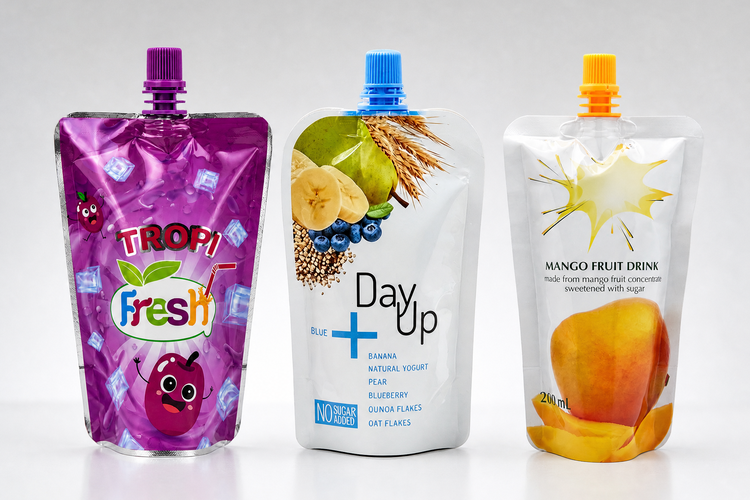
Stand-Up Spout Pouches
Stand-up juice pouches feature a bottom gusset that allows the package to remain upright on retail shelves. They are suitable for fruit drinks, juice beverages, smoothies, and other liquid products.
Corner Spout Pouches
A corner spout is positioned at one upper corner of the pouch, allowing convenient pouring and controlled dispensing. This design can be suitable for products consumed directly or poured into another container.
Top-Center Spout Pouches
A top-center spout provides a different dispensing position and can be considered according to the filling equipment and product presentation requirements.
When developing custom juice pouch packaging, buyers should confirm:
Pouch dimensions and filling capacity
Spout position and opening diameter
Cap style and color
Required dispensing speed
Whether resealing is necessary
Compatibility with filling and capping equipment
For beverage brands looking for different pouch configurations, our [Custom Spout Pouches] can be tailored with different pouch styles, spout positions, sizes and cap options to meet specific filling and packaging requirements.
3. Select Suitable Materials for Juice Pouch Packaging
Material selection is one of the most important decisions in custom juice pouch development.
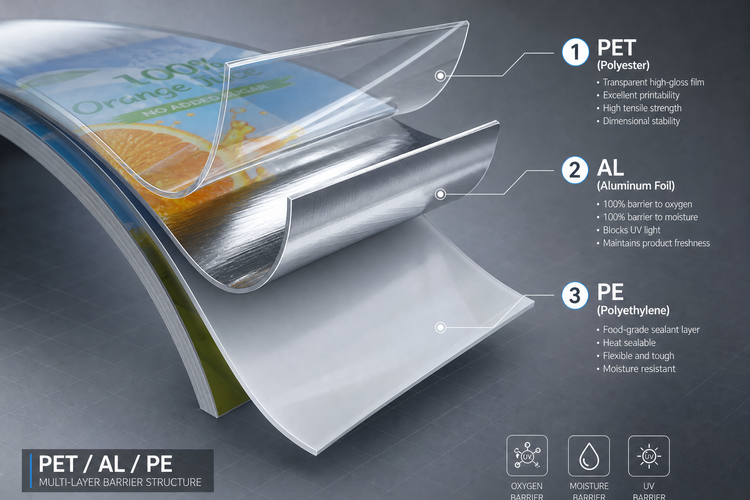
A laminated pouch typically combines different film layers to provide printing quality, mechanical strength, barrier protection, and heat-sealing performance.
Common material options include:
PET/AL/PE
This structure combines the printing and mechanical properties of PET, the high barrier properties of aluminum foil, and the heat-sealing properties of PE. It can be considered for juice products requiring strong protection against oxygen, moisture, and light, subject to filling and processing conditions.
PET/NY/PE
PET/NY/PE combines polyester, nylon, and polyethylene. Nylon provides additional toughness and puncture resistance, while PE serves as the inner sealing layer. It can be considered for liquid packaging applications requiring mechanical durability.
The final structure should depend on the beverage formulation, filling temperature, required shelf life, and distribution conditions.
Choosing the right material structure is an important part of developing reliable [Laminated Flexible Packaging]. The final combination of film layers should be determined by the beverage characteristics, filling conditions and required shelf life.
4. Develop the Spout-to-Pouch Sealing System
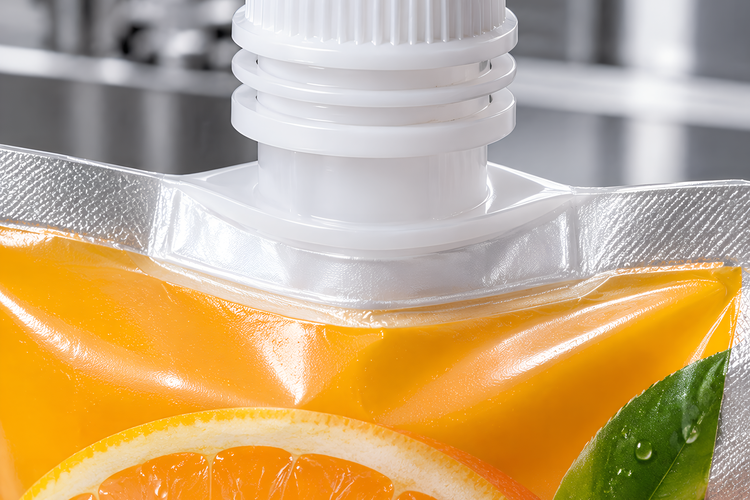
The spout is one of the most critical components of a juice spout pouch.
Unlike a conventional sealed pouch, a spout pouch contains an additional connection area between the rigid plastic fitment and the flexible laminated film.
The spout and pouch must form a reliable sealing system.
Important considerations include:
Spout Material Compatibility
The spout material must be compatible with the pouch’s inner sealing layer. The fitment design and welding process should be evaluated together.
Spout Position
The position of the spout affects filling, dispensing, pouch appearance, and the available sealing area.
Heat-Sealing Temperature
The temperature must be sufficient to create a complete bond between the spout flange and pouch film without damaging the surrounding laminate.
Sealing Pressure and Dwell Time
Pressure and sealing time must be controlled to achieve consistent bonding around the entire spout flange.
These parameters should be verified through production trials rather than relying on appearance alone.
5. Ensure Printing Quality and Custom Branding
Custom printed juice pouches help beverage brands establish a recognizable product identity.
The large printable surface of flexible packaging provides opportunities to display brand logos, product information, flavor variations, and promotional graphics.
When developing custom printed juice pouches, buyers should consider:
Brand logo and artwork positioning
Color consistency
Matte or gloss finishes
Product information and barcode placement
Printing repeat and pouch dimensions
Visual consistency across different flavors and sizes
The artwork should be developed according to the final pouch dimensions and spout position to avoid important design elements being covered or affected by sealing areas.
In addition to material and pouch design, [Custom Printed Packaging] helps beverage brands maintain consistent visual presentation across different pouch sizes and product ranges.
6. Match the Pouch Design with Commercial Filling Equipment
A packaging design must work with the actual beverage filling process.
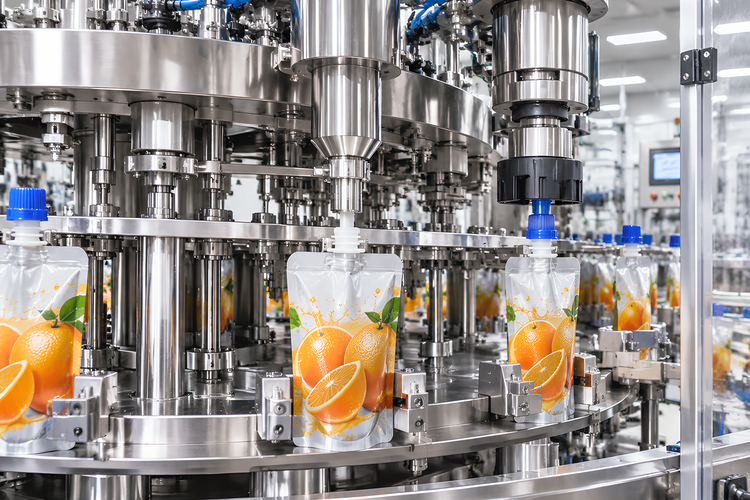
Commercial juice production may involve pre-made spout pouches, automatic filling systems, and capping equipment.
Before mass production, buyers should confirm:
Pouch dimensions and opening position
Spout neck and flange specifications
Filling nozzle compatibility
Filling speed and accuracy
Cap application and tightening requirements
Product temperature during filling
Headspace and filling volume
The packaging supplier should receive the relevant filling-line specifications before finalizing the pouch design.
A pouch that looks suitable as an empty sample may still require adjustments when tested on the actual filling equipment.
7. Real Production Case: Juice Leakage at the Spout Sealing Area
One practical quality issue encountered in spout pouch production is liquid leakage around the connection between the spout and pouch body.
In one actual production case, finished spout pouches developed leakage at the spout sealing area.
After investigation, the issue was traced to insufficient heat-sealing temperature during the spout welding process. The temperature was not high enough to create a complete bond between the spout flange and the inner sealing layer of the pouch film.
This resulted in an incomplete sealing area and allowed liquid to escape during use or handling.
The corrective action focused on reviewing and adjusting the spout sealing temperature to achieve more reliable bonding.
This case highlights an important point in custom juice pouch development: the sealing quality around the spout must be treated as a critical quality-control point, not simply as another part of the pouch manufacturing process.
Temperature, pressure, dwell time, material compatibility, and sealing consistency should all be evaluated together.
This case highlights why flexible packaging sealing quality must be verified during production rather than relying only on the appearance of the finished pouch.
8. Conduct Packaging Tests Before Bulk Production
Before placing a large-volume order, beverage manufacturers should evaluate the finished pouch under actual production conditions.
Recommended checks include:
Spout-to-pouch sealing integrity
Pouch edge sealing strength
Leakage and pressure resistance
Cap fit and closure performance
Filling-line compatibility
Drop and handling performance
Product and material compatibility
Appearance after storage
For hot-filled or retort beverages, testing must also reflect the intended thermal processing conditions.
A consistent [flexible packaging quality control] process helps identify potential sealing, material compatibility and leakage issues before commercial production begins.
9. What Information Is Needed for a Custom Juice Pouch Quotation?
To develop suitable custom juice pouch packaging, buyers should prepare the following information:
Product Details: Juice type, formulation, viscosity, and whether fruit pulp is present.
Pouch Size: Required dimensions and filling capacity.
Spout Specifications: Position, opening diameter, material, and cap design.
Material Requirements: Preferred laminate structure and barrier requirements.
Filling Conditions: Cold filling, hot filling, or retort processing.
Printing Requirements: Artwork, colors, and surface finish.
Production Quantity: Estimated order quantity for each pouch size and design.
Providing complete information allows the packaging manufacturer to evaluate material compatibility, spout design, and production requirements more accurately.
Custom Juice Pouch Manufacturer – HUIYANG PACKAGING
HUIYANG PACKAGING provides customized flexible packaging solutions for beverage brands and commercial packaging buyers.
Our custom juice pouch solutions can be developed according to different product applications, pouch dimensions, material structures, spout positions, cap requirements, and printing designs.
We focus on material selection, laminated film quality, spout sealing performance, and customized production requirements to help customers develop packaging suitable for their beverage products.
Whether you are launching a new juice product or upgrading an existing beverage packaging format, our team can help evaluate your packaging specifications.
Looking for a reliable custom juice pouch manufacturer?
Contact HUIYANG PACKAGING with your juice product details, required pouch size, filling conditions, and spout specifications.
Let’s discuss a customized juice pouch packaging solution for your commercial beverage production.
Post time: Nov-11-2026