


As pet food brands expand their product portfolios, managing packaging for multiple SKUs becomes increasingly challenging. A single brand may offer different flavors, formulas, product types, and package weights, each requiring specific packaging dimensions, material structures, and barrier properties.
For pet food manufacturers, private-label brands, and packaging procurement teams, multi-SKU pet food packaging is not simply about printing different designs on the same bag. It requires a coordinated packaging strategy that balances product protection, brand consistency, production efficiency, and purchasing costs.
So, how can pet food brands develop custom packaging for multiple products without creating unnecessary complexity in their supply chains?
This guide explains the key considerations for designing flexible packaging across different pet food SKUs.
1. Build a Packaging Specification Matrix for Different SKUs
The first step in developing custom pet food packaging is to classify products according to their physical characteristics and packaging requirements.
A pet food brand may offer:
Dry dog food in different formulas and weights
Dry cat food with multiple flavors
Freeze-dried pet food and treats
Semi-moist snacks and functional treats
Pet supplements and nutritional powders
Although these products belong to the same brand, they may have different packaging requirements.
For example, dry kibble generally requires moisture protection and sufficient mechanical strength. High-fat pet treats may need additional oxygen and aroma protection to help reduce oxidation. Freeze-dried products require careful moisture-barrier consideration to maintain product quality.
Instead of developing every SKU independently, brands should establish a packaging specification matrix.
A practical matrix should include:
Product type and formula
Net weight and filling volume
Pouch style and dimensions
Material structure and thickness
Barrier requirements
Closure and opening features
Printing artwork and product information
This approach helps packaging buyers identify which SKUs can share similar packaging specifications and which require individual solutions.
2. Choose the Right Pet Food Packaging Bags and Pouch Styles
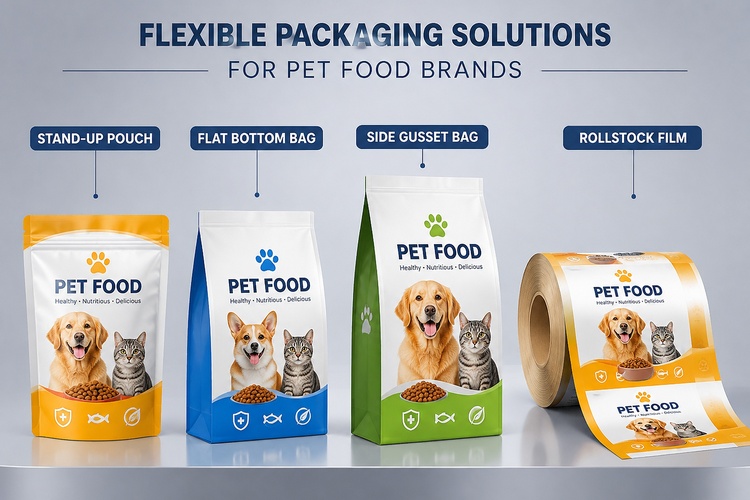
Different product weights do not necessarily require completely different packaging designs. However, pouch dimensions, bottom construction, and seal strength must match the actual filling weight and product characteristics.
Common pet food packaging bags and flexible packaging formats include:
Stand-up pouches are suitable for smaller packages of pet treats, dry food, and specialty pet products. Their bottom gussets help the packages stand upright on retail shelves, while resealable zippers make repeated opening and closing more convenient.
Brands can consider custom stand-up pouches for different product weights, flavors, and retail packaging requirements.
Flat bottom bags provide a structured appearance and multiple printable panels. They are commonly considered for premium pet food products where shelf presentation and package stability are important.
Side gusset bags provide additional capacity and are suitable for larger quantities of dry pet food. Their dimensions, material thickness, and mechanical strength should be evaluated according to filling weight and transportation conditions.
For pet food manufacturers using automatic form-fill-seal equipment, custom printed rollstock film can support different package sizes and production requirements.
Film width, roll diameter, core size, sealing properties, and compatibility with filling equipment should be confirmed before production.
The right flexible packaging for pet food should be selected according to product weight, density, filling method, and distribution requirements rather than appearance alone.
3. Select Suitable Materials for Different Pet Food Products
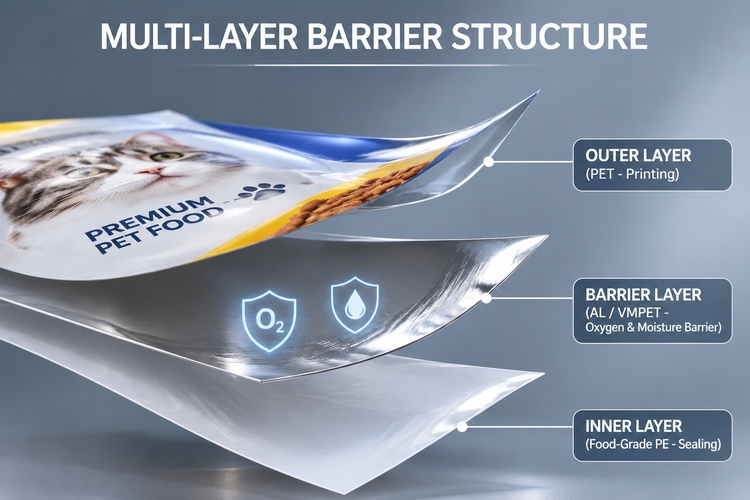
One of the biggest mistakes in multi-SKU packaging design is assuming that every product under the same brand can use an identical material structure.
Different pet food formulas may have different sensitivity to moisture, oxygen, grease, and external contamination.
For example:
Dry kibble: Requires appropriate moisture protection, mechanical strength, and reliable seals.
High-fat pet treats: May require stronger oxygen and aroma barriers to help reduce oxidation.
Freeze-dried food: Requires careful moisture-barrier consideration to protect product quality.
Powdered supplements: Need suitable sealing performance and consideration of powder contamination around the seal area.
Common laminated flexible packaging structures include PET/PE, PET/VMPET/PE, and PET/AL/PE.
Each structure offers different performance characteristics. The final material selection should depend on the product’s shelf-life target, storage environment, filling process, and required packaging performance.
Understanding laminated flexible packaging materials helps brands make better decisions when developing packaging for multiple product categories.
For brands planning several SKUs, it may be possible to standardize certain material specifications across products with similar requirements. However, this should only happen after technical evaluation and packaging performance testing.
4. Maintain Brand Consistency While Differentiating Each SKU
A multi-SKU product range needs to look like one brand while allowing consumers to identify different products quickly.
A consistent packaging design system can help achieve this.
Keep the Core Brand Identity Consistent
Use the same logo, brand typography, basic layout, and major visual elements across the product range.
Use Color Coding for Different Products
Assign different colors to different flavors, formulas, or product categories. For example, chicken, salmon, and beef formulas can use different accent colors while maintaining the same overall design structure.
Make Product Information Easy to Identify
Each SKU should clearly display its product name, formula, net weight, nutritional information, and other required labeling details.
Develop a Master Artwork Template
Create a master artwork template and adapt individual SKU information within a controlled design system.
This makes it easier to manage artwork revisions and maintain visual consistency across different package sizes.
For custom printed pet food bags, artwork approval should cover every SKU, not just one representative design. Brands should check product names, ingredient information, barcode numbers, net weights, and other variable details before approving bulk production.
5. Optimize Printing and Production Costs Across Multiple SKUs
Printing and production planning can become complicated when a brand has many packaging designs.
For example, a brand launching five flavors in three different package weights may need to manage fifteen individual packaging specifications.
If every SKU requires a completely separate production setup, purchasing costs and production coordination can increase.
Here are several ways to improve multi-SKU packaging management.
Group Similar Specifications
Identify products that can share the same material structure, thickness, and pouch format. This helps simplify material purchasing and technical management.
Standardize Where Practical
Where product requirements allow, standardize certain pouch dimensions, zipper specifications, or material structures. Avoid unnecessary variations.
Plan Printing Quantities Carefully
Printing costs depend on factors such as printing method, number of designs, material consumption, and production quantities.
Discuss the production plan for
Post time: Nov-11-2026