


Introduction: Why Is Packaging Protection More Important for E-Commerce?
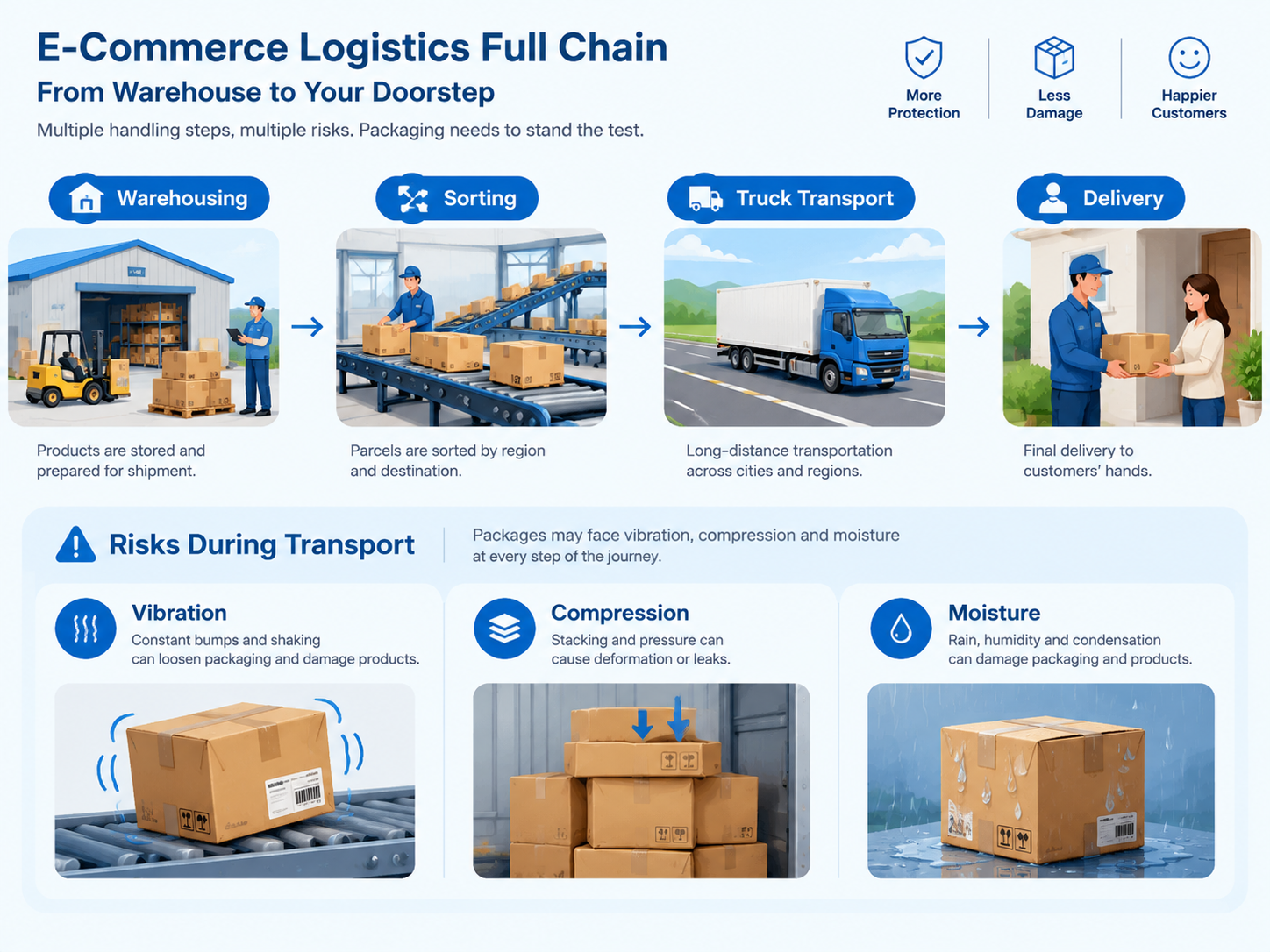
E-commerce products often pass through multiple stages before reaching the customer, from filling and warehousing to sorting, transportation, and final delivery. Along the way, packages may be exposed to vibration, compression, impact, moisture, temperature changes, and repeated handling. This makes packaging performance an important part of product protection—not just a matter of appearance.
For brands selling coffee, snacks, pet food, supplements, cosmetics, and household products online, the right packaging needs to balance protection, usability, shipping efficiency, and brand presentation. The packaging structure also needs to match the product’s characteristics, filling method, shelf-life requirements, and expected shipping conditions.
Flexible packaging is widely used for e-commerce products because it can be customized in terms of material structure, thickness, pouch format, printing, and functional features. Depending on the application, multilayer flexible packaging can provide protection against factors such as oxygen, moisture, and light while maintaining reliable sealing performance. Its lightweight format can also help brands use storage space efficiently and manage packaging weight during shipping.
For example, coffee may require strong oxygen and light protection to help preserve freshness and aroma, while snacks often need good moisture resistance to maintain texture. Pet food may require a combination of material strength, moisture protection, reliable sealing, and resealability. Choosing the right flexible packaging therefore starts with understanding the product and the conditions it will face throughout the e-commerce delivery process.
What Challenges Do E-Commerce Products Face During Shipping?
E-commerce products can go through several stages before reaching the customer, including warehousing, order fulfillment, sorting, transportation, and last-mile delivery. During this process, packages may be exposed to stacking pressure, accidental impact, repeated handling, moisture, and temperature changes.
The packaging therefore needs to provide more than an attractive appearance. It should be selected according to the product’s physical characteristics, shelf-life requirements, filling method, and expected shipping conditions.
1. Physical Damage During Transportation
Packages may be stacked with other parcels, moved through automated sorting systems, or handled repeatedly during delivery. If the packaging structure or sealing performance is not suitable for the product, these conditions may increase the risk of:
- Compression and deformation
- Punctures or tears
- Seal failure
- Product leakage
- Damage caused by repeated handling
For products sold online, packaging strength should be considered together with the product weight, pouch size, material structure, and filling method. A suitable flexible packaging structure can provide the required combination of strength, flexibility, and sealing performance without using unnecessary material.
2. Moisture, Oxygen, and Temperature Changes
Environmental conditions can also affect products during transportation and storage. High humidity, rainwater, temperature fluctuations, and prolonged exposure to oxygen may affect product quality, depending on the type of product.
For example, roasted coffee can gradually lose freshness and aroma when exposed to oxygen, while snacks and dried foods may lose their desired texture when moisture enters the package. Products with greater sensitivity to environmental conditions may therefore require high-barrier packaging with appropriate oxygen and moisture protection.
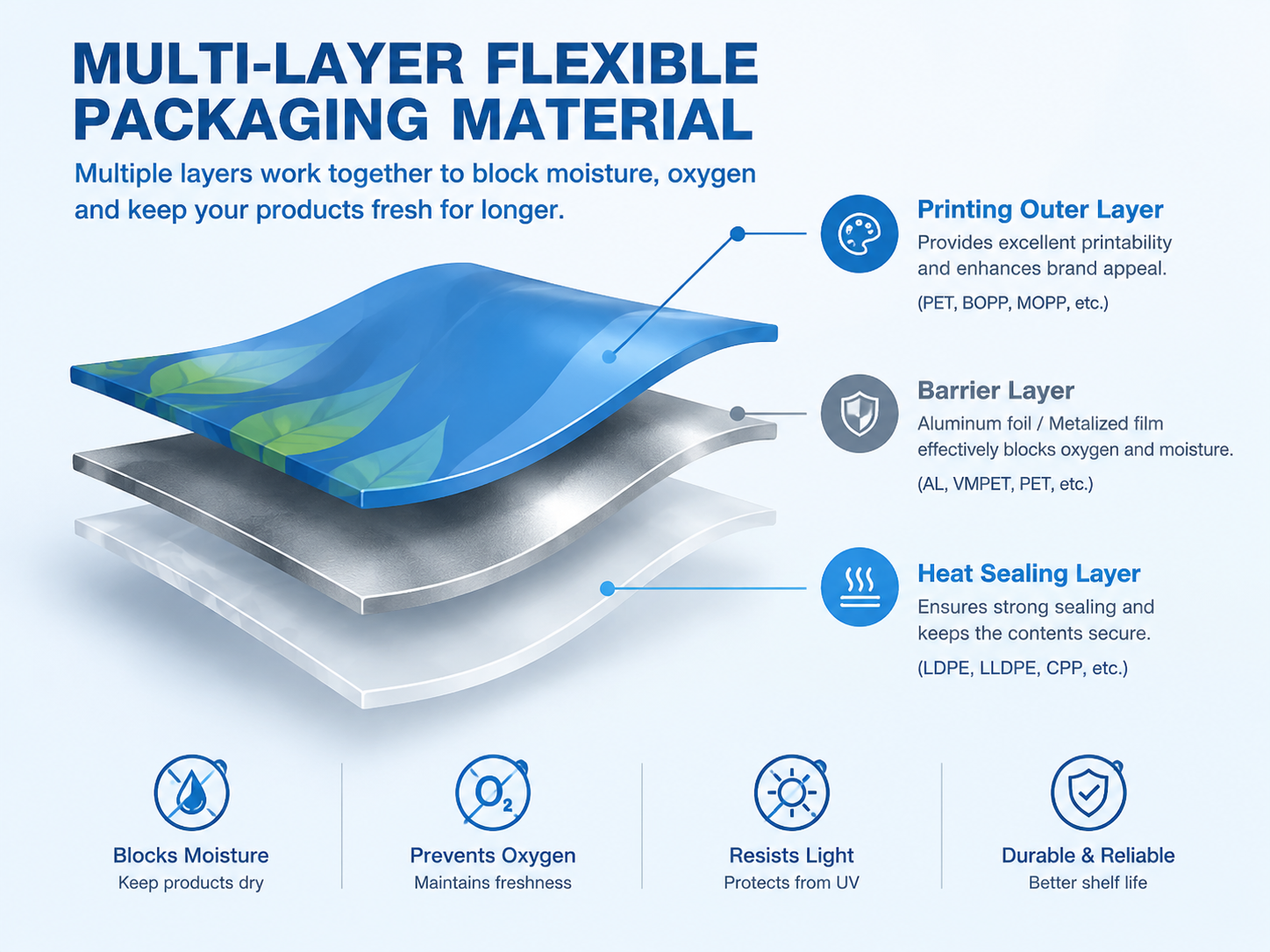
This is where multilayer flexible packaging materials can provide different functions within the same package. Individual layers can contribute to mechanical strength, heat-sealing performance, printability, and barrier protection.
For e-commerce brands, custom flexible packaging allows the material structure, pouch format, dimensions, printing, and selected functional features to be matched to the product and its shipping requirements. Instead of using the same packaging structure for every product, brands can develop a solution based on the actual protection and handling needs of each application.
How Can Flexible Packaging Help Protect E-Commerce Products?
The right flexible packaging can help protect e-commerce products by combining suitable material structures, reliable sealing, practical pouch formats, and functional features. However, there is no single packaging solution for every product. Material selection and package design should be based on the product’s characteristics, filling method, shelf-life requirements, and shipping conditions.
1. High-Barrier Materials for Product Protection
Many food and other sensitive products need protection from oxygen, moisture, light, or external contamination. Depending on the application, multilayer flexible packaging can incorporate barrier layers to help maintain product quality throughout storage and distribution.
For example, coffee packaging may use aluminum foil or metallized film structures when stronger protection against oxygen and light is required. Snack packaging often places greater emphasis on moisture resistance to help maintain the desired texture.
The appropriate barrier level depends on the product and its shelf-life requirements. Using a suitable material structure can provide the necessary protection without adding unnecessary packaging layers.
2. Reliable Sealing Performance
Sealing performance is another important consideration for e-commerce packaging. Packages may be handled repeatedly during sorting and delivery, so the seal needs to remain intact throughout the distribution process.
Heat sealing creates the primary closure of many flexible packaging bags. The actual sealing performance depends on the sealing layer, material structure, package design, filling conditions, and sealing process.
For products that are opened and consumed over several occasions, a resealable zipper can be added to improve convenience after the initial opening. The zipper works together with the primary package seal rather than replacing it.
3. Lightweight and Space-Efficient Packaging
Packaging weight and volume can affect logistics and warehouse efficiency, especially for brands handling a large number of e-commerce orders.
Flexible packaging is generally lightweight and can be stored efficiently before filling. Compared with many rigid packaging formats, this can help brands:
- Manage packaging inventory more efficiently
- Reduce unnecessary packaging weight
- Use warehouse space more effectively
- Optimize packaging for shipping and fulfillment
The goal is not simply to make the package as thin or light as possible, but to achieve an appropriate balance between material performance and packaging efficiency.
Which Flexible Packaging Features Are Useful for E-Commerce?
Beyond the basic material structure, functional features can improve package usability and make the product more suitable for direct-to-consumer delivery.
1. Resealable Zipper
For products that are consumed over multiple occasions, a resealable zipper allows customers to open and close the package more conveniently after the initial opening.
Zipper pouches are commonly used for products such as:
- Coffee
- Snacks
- Pet food
- Nuts
- Dried fruit
- Powdered products
The zipper can improve convenience while helping the package remain closed between uses.
2. Easy-Tear Opening
A tear notch provides a simple way to open a flexible pouch without scissors or other tools.
This feature can be useful for snack packaging, coffee pouches, supplement packaging, and other products where convenient opening is important to the customer experience.
For e-commerce brands, an easy-to-open package can also contribute to a smoother unboxing experience.
3. Stand-Up and Flat Bottom Pouch Structures
Different pouch structures provide different functional and visual benefits.
Stand-up pouches can remain upright when filled, making them suitable for products that require convenient shelf or countertop presentation. They also provide a relatively large printable surface for branding and product information.
For products requiring a more structured format and larger filling capacity, flat bottom pouches, also known as eight-side seal pouches, can provide a stable base and multiple printable panels. These formats are commonly used for coffee, pet food, snacks, and other packaged products.
The pouch style can be selected according to the product volume, filling method, storage requirements, and desired appearance.
4. Custom Printing and Branding
For e-commerce products, packaging is part of the customer’s first physical interaction with the brand.
Custom printing allows brands to display logos, product information, graphics, instructions, and other visual elements directly on the package. A well-designed package can create a consistent brand experience from the online product listing to the customer’s unboxing experience.
For food and beverage brands, custom food packaging bags can therefore combine product protection with customized branding. The printing design, pouch format, dimensions, material structure, and selected functional features can be developed according to the product’s requirements.
Case Example: Choosing Flexible Packaging for E-Commerce Pet Food
Pet food is a good example of how e-commerce can change packaging requirements. When products are sold online, the package may experience repeated handling, stacking, and longer transportation distances before reaching the customer. At the same time, pet food needs to remain properly protected during storage and after the package is opened.
For an e-commerce pet food brand, the packaging solution needs to balance product protection, package strength, convenience, and brand presentation.
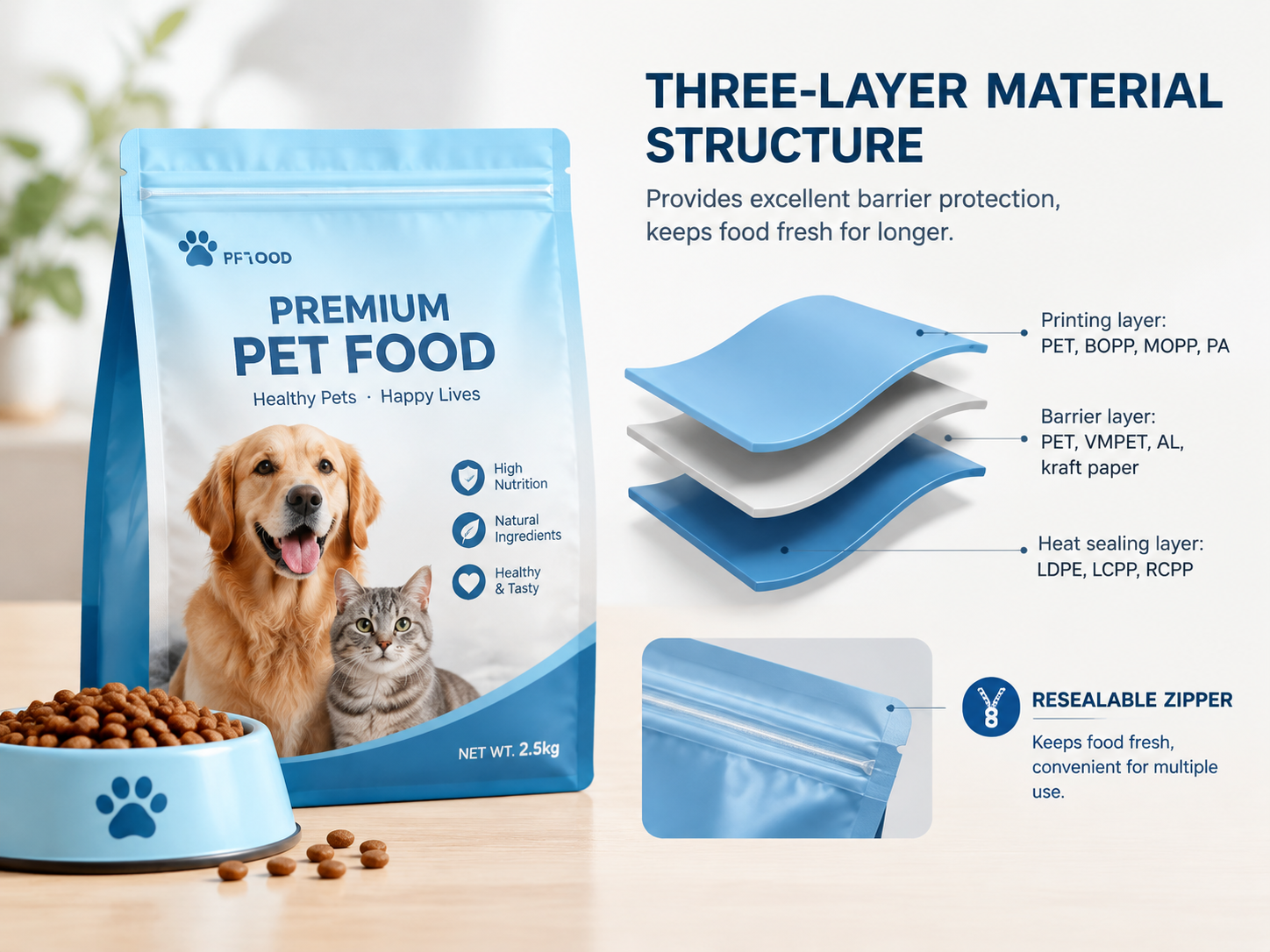
A customized pet food packaging solution can use a suitable multilayer material structure to provide protection against moisture and external contamination. Depending on the product and shelf-life requirements, the packaging structure can also be designed with appropriate barrier properties against oxygen and other external factors.
For products that customers use over multiple occasions, a resealable zipper can make the package easier to open and close after the initial opening. This is particularly useful for pet food products that are not consumed in a single serving.
The pouch format can also be selected according to the product weight and filling requirements. Stand-up pouches are suitable for products that require upright presentation, while larger or more structured formats such as flat bottom pouches can provide a stable base and multiple printable panels.
Custom printing adds another layer of functionality for e-commerce brands. The package can display the brand logo, product information, feeding instructions, product images, and other graphics, helping create a consistent visual experience from the online product listing to the physical package received by the customer.
This example highlights an important principle of e-commerce packaging: the right solution should be designed around the complete product journey. Material structure, pouch format, sealing performance, functional features, and printing should work together to meet both product protection and consumer-use requirements.
For pet food brands selling through e-commerce channels, customized pet food packaging provides the flexibility to develop packaging around specific product, filling, shipping, and branding requirements.
How Should E-Commerce Brands Choose the Right Flexible Packaging Solution?
Choosing flexible packaging for an e-commerce product is not simply a matter of selecting a pouch style or the lowest-cost material. The packaging should be matched to the product, filling process, shelf-life requirements, shipping conditions, and customer usage.
1. Start with the Product’s Protection Requirements
Different products require different levels of protection.
Food products may need protection against moisture, oxygen, or light. Coffee, for example, may require a higher barrier structure to help preserve freshness and aroma. Snacks and dried foods often place greater emphasis on moisture resistance, while liquid or semi-liquid products require reliable sealing and suitable material compatibility.
Before selecting a packaging structure, brands should consider:
- Product type and physical characteristics
- Filling weight and package size
- Shelf-life requirements
- Sensitivity to oxygen, moisture, or light
- Storage conditions
- Whether the package will be opened and resealed after purchase
This information provides a better starting point for selecting the appropriate flexible packaging materials and pouch structure.
2. Consider the Complete Shipping Environment
Shipping distance is only one part of the packaging decision. E-commerce products may experience different levels of handling, compression, humidity, temperature variation, and transportation time depending on the logistics process.
For products shipped internationally or stored for longer periods, brands may need to pay closer attention to barrier performance, package strength, and seal integrity. However, the packaging should not automatically be made thicker or heavier simply because the product travels farther.
The better approach is to evaluate the actual shipping and storage conditions and then select a suitable material structure and pouch format.
For example, a lightweight structure may be sufficient for a relatively stable product with moderate protection requirements, while a moisture- or oxygen-sensitive product may require a higher-barrier structure regardless of whether it is shipped locally or internationally.
3. Balance Protection, Cost, and Shipping Efficiency
Packaging cost is important for e-commerce brands, particularly when order volumes increase. However, selecting packaging based only on the lowest unit price may not provide the best overall value.
A suitable packaging solution should consider the total cost of the package, including:
- Packaging material
- Production efficiency
- Shipping weight and package volume
- Warehouse storage
- Product protection
- Potential product loss or returns
At the same time, using a more complex material structure than the product actually requires can unnecessarily increase packaging costs.
The goal is to find the right balance between protective performance, packaging cost, production efficiency, shipping requirements, and brand presentation.
4. Match the Pouch Format to the Filling and Consumer Experience
The pouch structure should also fit the way the product is filled and used.
For example, stand-up zipper pouches can be suitable for products that are opened and consumed over multiple occasions. Flat bottom or eight-side seal pouches may be considered for products requiring a more structured format or larger filling capacity. For products packed using automatic equipment, roll film may be more appropriate than pre-made pouches.
Functional features such as zippers, tear notches, handles, or other options should be selected according to the actual product and usage requirements rather than added simply for appearance.
5. Work with a Flexible Packaging Manufacturer Early
An experienced flexible packaging manufacturer can help brands evaluate the relationship between material structure, pouch format, filling method, printing requirements, and shipping conditions before production.
For custom flexible packaging, providing information such as product type, filling weight, target pouch dimensions, packaging process, expected shelf life, and shipping environment can help the manufacturer recommend a more suitable packaging structure.
The best e-commerce packaging solution is not necessarily the thickest, lightest, or cheapest option. It is the solution that provides the required product protection while remaining practical for production, shipping, storage, and consumer use.
Conclusion
Choosing the Right Flexible Packaging for E-commerce packaging needs to protect products throughout the entire delivery journey while also supporting efficient storage, shipping, and a positive customer experience.Flexible packaging offers a versatile solution because its material structure, pouch format, dimensions, printing, and functional features can be customized according to different product requirements. From high-barrier coffee packaging to resealable snack and pet food pouches, the right packaging structure can help address specific protection and usability needs.The key is not simply to choose the lightest, strongest, or lowest-cost package. Brands should consider product characteristics, shelf-life requirements, filling methods, shipping conditions, and consumer usage when developing their packaging solution.By working with an experienced flexible packaging manufacturer, e-commerce brands can develop packaging that provides the required product protection while balancing production efficiency, shipping considerations, cost, and brand presentation.
For brands looking for custom flexible packaging for e-commerce products, the right material structure and pouch design can turn packaging from a basic shipping container into an important part of the overall product experience.
FAQ: Flexible Packaging for E-Commerce Shipping
1. Is flexible packaging strong enough for e-commerce shipping?
Yes, when the material structure and pouch design are properly matched to the product and shipping conditions. Multilayer flexible packaging can provide mechanical strength, moisture resistance, barrier protection, and reliable sealing performance. The appropriate structure depends on factors such as product weight, pouch size, filling method, and transportation conditions.
2. What products are suitable for flexible packaging?
Flexible packaging is widely used for products such as coffee, snacks, pet food, dried foods, supplements, cosmetics, and household products. Different applications may require different material structures, pouch formats, and functional features depending on product characteristics and shelf-life requirements.
3. Can flexible packaging help reduce shipping costs?
Flexible packaging is generally lightweight and can be stored efficiently before filling. Compared with many rigid packaging formats, this may help brands manage packaging weight, storage space, and logistics efficiency. Actual shipping costs depend on factors such as product weight, package dimensions, order volume, and shipping method.
4. Can flexible packaging be customized with brand designs and features?
Yes. Custom flexible packaging can be produced with different pouch styles, dimensions, material structures, printing designs, and selected functional features. Depending on the application, options may include zippers, tear notches, handles, windows, or other packaging features. For products such as coffee, additional features such as a valve may also be considered when required.
5. How do I choose the right flexible packaging for my e-commerce product?
Start by evaluating the product’s physical characteristics, shelf-life requirements, sensitivity to oxygen or moisture, filling method, package size, and expected shipping conditions. Brands should also consider how the package will be opened and stored after delivery. An experienced flexible packaging manufacturer can help evaluate these requirements and recommend a suitable material structure and pouch format.
Post time: Oct-17-2026