


Opening a package should be simple, but achieving a reliable easy-open experience requires more than adding a small cut to the top of a bag. The packaging material, tear notch position, zipper design and heat-seal structure all influence how easily a consumer can access the product.
For brands sourcing custom flexible packaging, these details matter just as much as printing quality and shelf appearance. A snack pouch that is difficult to tear may frustrate consumers, while a coffee bag that cannot be resealed properly may expose the remaining beans to air and moisture.
So, what makes flexible packaging easy to open without compromising product protection?
This guide explains how tear notches, resealable zippers and seal design work together, with practical examples of coffee packaging bags and snack packaging pouches.
1. Why Easy-Open Flexible Packaging Matters
Flexible packaging is widely used for snacks, coffee, nuts, dried fruit and many other products because it combines lightweight construction with flexible design options and protective material structures.
However, a package has two different jobs: protecting the product before opening and providing convenient access after purchase.
These requirements can sometimes conflict. A strong heat seal helps protect the contents during transportation and storage, but an excessively difficult opening experience can reduce consumer satisfaction. Similarly, a zipper allows repeated access, but it does not replace the original factory seal.
Well-designed easy-open packaging balances three key factors:
- · Opening convenience: Consumers can start and complete the opening process without excessive force.
- · Package integrity: The seals remain intact during filling, transportation and storage.
- · Product usability: The package can be poured, accessed or resealed according to how the product is consumed.
The best solution depends on the product, packaging structure and intended usage rather than on one feature alone.
2. Tear Notches: A Simple Way to Open Packaging Bags
A tear notch is a small cut or indentation near the top edge of a flexible pouch. It creates a starting point for tearing, helping consumers open the package without scissors.
Tear notches are commonly used on stand-up pouches, three-side-seal bags, snack packaging bags and single-serve sachets.
How does a tear notch work?
Without a designated starting point, consumers may struggle to tear through several layers of laminated packaging film. A properly positioned notch makes it easier to initiate the tear.
However, the notch alone does not guarantee a clean opening. Its position, shape, the direction of tearing and the properties of the laminated film all affect the result.
The notch must also be positioned carefully so that it does not compromise the package’s sealed area before the consumer opens it.
Practical example: Custom snack packaging bags
Consider a stand-up pouch containing potato chips, nuts or dried fruit. Consumers may open the bag immediately after purchase and finish the contents in one sitting.
For this application, a custom snack packaging bag with a tear notch may provide sufficient convenience without requiring an additional closure feature.
For larger snack packs intended for multiple servings, combining a tear notch with a resealable zipper is often more practical.
The key is to consider how consumers will use the product after the first opening, not simply how they will open it for the first time.
3. Resealable Zippers: Convenience Beyond the First Opening
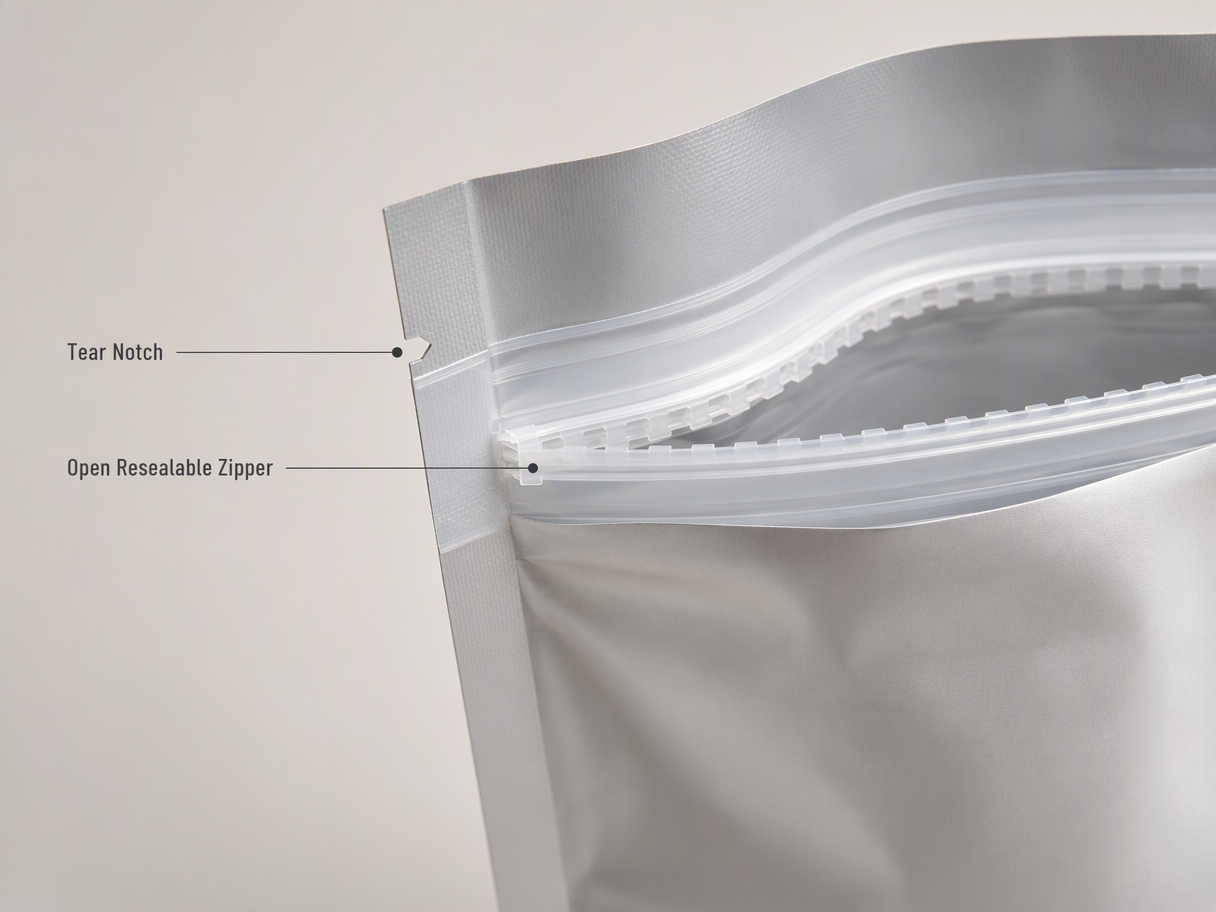
A tear notch helps consumers open a package for the first time. A resealable zipper allows them to close it again after use.
This distinction is particularly important for products that are consumed gradually rather than all at once.
Common zipper options include:
- · Press-to-close zipper: The two interlocking tracks are pressed together by hand. This is a common choice for snack pouches and coffee bags.
- · Slider zipper: A sliding mechanism opens and closes the zipper track. It can be convenient for larger packages or products that require frequent access.
The appropriate zipper depends on pouch dimensions, product characteristics, target price and consumer expectations.
A zipper should also be compatible with the packaging material and securely attached to the pouch. If product particles become trapped in the tracks, the zipper may not close properly.
Practical example: Custom coffee packaging bags
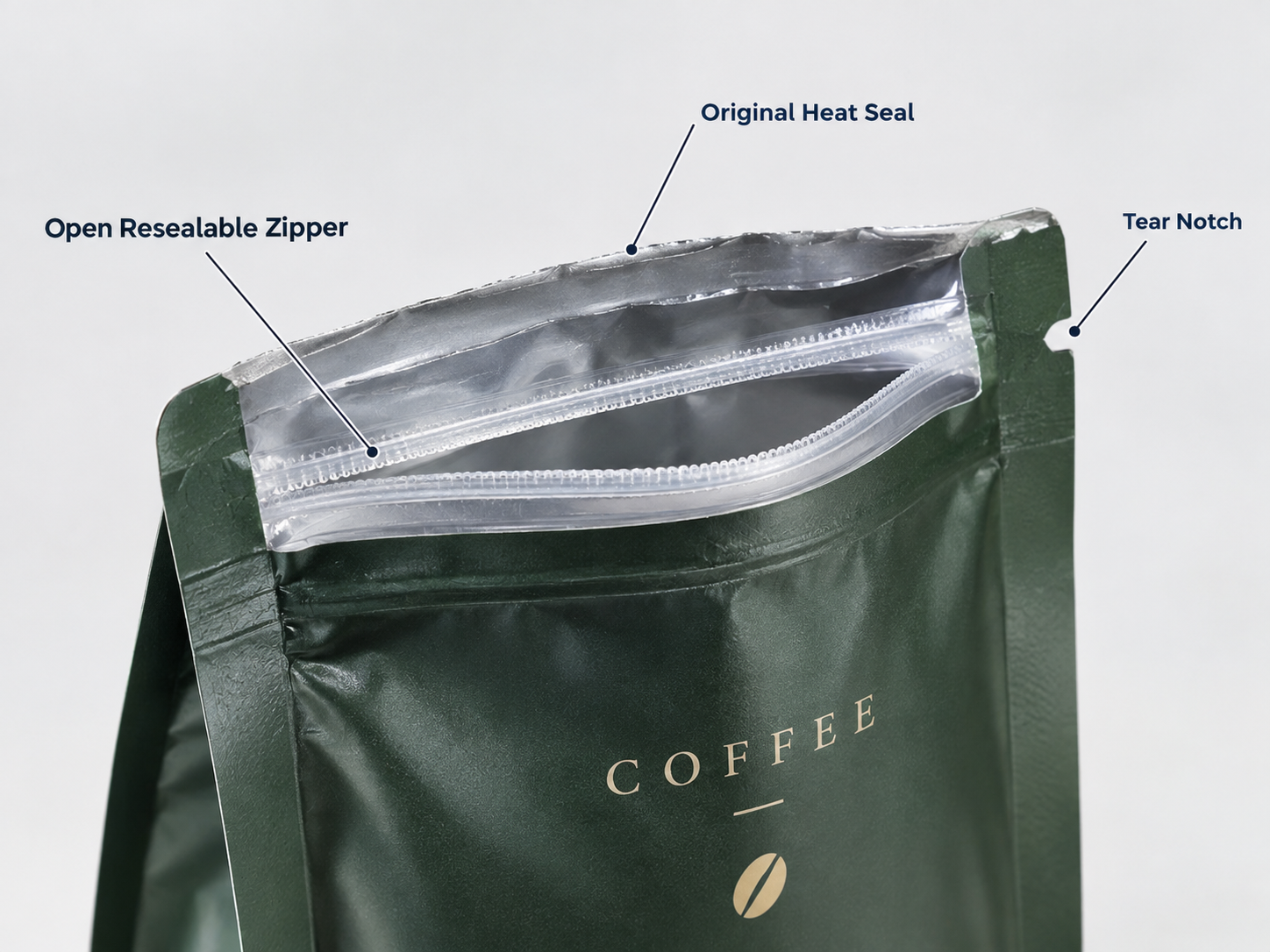
Coffee packaging illustrates why opening and resealing features need to be considered together.
For example, a brand selling coffee beans in a custom stand-up coffee bag with a zipper may want consumers to open the package, take out the required quantity and close it again.
A tear notch provides access through the original top seal, while the zipper supports subsequent opening and closing.
For coffee beans or ground coffee, the packaging material must also be selected according to the required barrier performance and shelf-life conditions. A zipper alone does not provide the same protection as an unopened, properly sealed package.
Some coffee bags also incorporate a one-way degassing valve to release gases from freshly roasted coffee. The valve serves a different purpose from the zipper and should be selected according to the coffee product and packaging requirements.
This example shows that easy-open design is not about choosing a single accessory. It involves coordinating the opening method, closure system and protective material structure.
4. Heat-Seal Design: The Balance Between Protection and Opening
Heat sealing is one of the most important processes in flexible packaging production. It joins compatible sealant layers to close the package and help protect the contents.
For many laminated pouches, the top seal must be strong enough to withstand normal handling and distribution while remaining compatible with the intended opening method.
Stronger does not always mean better
An excessively weak seal may open prematurely or fail during transportation. On the other hand, a seal that is unnecessarily difficult to separate can make the package frustrating to open.
The right balance depends on the material structure, seal width, sealing conditions, pouch design and product requirements.
It is also important to distinguish between two functions:
Primary heat seal: Closes the package during manufacturing and protects the contents before opening.
Resealable zipper: Allows the consumer to close the pouch again after the original seal has been opened.
A zipper does not replace the primary heat seal, and a strong primary seal does not automatically make a package easy to open.
What about easy-peel seals?
Some packaging applications use easy-peel sealing structures that allow a controlled opening by separating the sealed layers.
These structures are different from conventional tear-notch openings. They may be suitable for specific packaging formats, but their performance depends on the material combination and the intended filling and sealing process.
For custom flexible packaging, seal design should therefore be evaluated together with the proposed opening method rather than specified as an isolated feature.
5. How to Match Opening Features to Different Products
Different products have different opening requirements. The following examples provide a practical starting point when selecting custom packaging bags.
|
Product application |
Suggested opening features |
Main consideration |
| Single-serve snack pouch | Tear notch | Quick, one-time access |
| Multi-serving nut or snack pouch | Tear notch + zipper | Easy opening and repeated use |
| Coffee bean packaging bag | Tear notch + zipper; optional degassing valve | Resealing and suitable barrier performance |
| Ground coffee pouch | Tear notch + zipper, depending on format | Closure performance and protection from moisture and oxygen |
| Powdered food pouch | Tear notch + suitable zipper, if needed | Powder contamination of the zipper track |
| Single-use sauce or seasoning sachet | Tear notch or another suitable easy-open feature | Controlled opening and reduced spillage |
These are general design suggestions, not universal specifications. The final structure should be determined by the product, pouch size, material combination and filling conditions.
For example, a small snack pouch intended for immediate consumption may not need a zipper. Adding one could increase complexity without providing much benefit. A larger coffee pouch, however, may benefit from a zipper because consumers are likely to open it repeatedly.
6. How to Test Easy-Open Packaging Before Mass Production
A packaging design may look convenient on screen but behave differently after printing, lamination, pouch making and filling. For this reason, opening performance should be checked using samples representative of the intended production process.
Before approving a custom packaging bag, buyers and manufacturers should consider the following checks.
(1)Tear initiation
Can the user start tearing at the designated notch without excessive effort?
(2)Tear direction
Does the film tear along the intended path, or does it split unpredictably through the pouch body or seal?
(3)Zipper operation
Can the zipper be opened and closed repeatedly? Does it remain functional when used as intended?
(4)Seal integrity
Does the original heat seal remain intact during handling and distribution? Seal strength and leak integrity should be evaluated using appropriate methods for the package.
(5)Filled-package performance
Does the package remain easy to use when filled with the actual product? Powder, oil, product weight and the shape of the pouch can all affect performance.
Testing should reflect the actual packaging structure and intended use. A successful tear test on an empty film sample alone does not prove that a finished, filled pouch will perform equally well.
7. What Should Buyers Specify When Ordering Custom Flexible Packaging?
If you are sourcing custom printed packaging bags, discuss opening requirements with your packaging supplier before finalizing the artwork.
Provide the following information where available:
- · Product type and whether it is consumed in one sitting or over multiple uses.
- · Preferred pouch style, such as a stand-up pouch, flat pouch or flat-bottom bag.
- · Material structure and required barrier performance.
- · Whether a tear notch, resealable zipper or easy-peel seal is needed.
- · Bag dimensions, filling method and expected filling conditions.
- · Any special requirements for opening force, resealing or leak resistance.
These details help the manufacturer assess whether the proposed design is suitable for the application.
They also reduce the risk of discovering that an opening feature interferes with the seal area or does not perform as expected after the package is filled.
At HUIYANG PACKAGING, custom flexible packaging can be developed around different pouch styles, printed designs and functional requirements. The final material structure and opening features should be confirmed according to the specific product and production requirements.
Conclusion
Easy-open flexible packaging is the result of coordinated design rather than a single feature.
A tear notch provides a convenient starting point. A resealable zipper supports repeated use. Properly designed heat seals protect the product before opening, while appropriate testing helps verify that the package performs as intended.
Whether you are developing custom snack packaging bags, resealable coffee pouches or other flexible packaging products, consider the complete consumer experience before finalizing the design.
Looking for custom flexible packaging for your product?
Contact HUIYANG PACKAGING to discuss your bag style, material structure, size, printing requirements and preferred opening features. Our team can help you evaluate suitable options for your packaging project.
Post time: Oct-09-2026