


High-speed packaging lines are designed to improve production efficiency, reduce labor costs, and maintain consistent packaging quality. However, even advanced automatic packaging equipment cannot perform efficiently if the rollstock film is not properly matched to the machine.
For large food processing plants and automated packaging companies, sourcing the right custom rollstock film involves much more than choosing a material structure or printing a design. Incorrect film width, roll diameter, core size, winding direction, sealing layer, or print registration can lead to frequent machine adjustments, film waste, sealing defects, and unexpected production downtime.
These problems can increase packaging costs and reduce overall line efficiency.
So, how can packaging procurement managers select rollstock film that works reliably with high-speed packaging equipment?
This guide explains the key specifications to confirm before placing an order, from film dimensions and winding direction to sealing performance, printing position, and machine compatibility.
1.Start with Your Packaging Machine Specifications
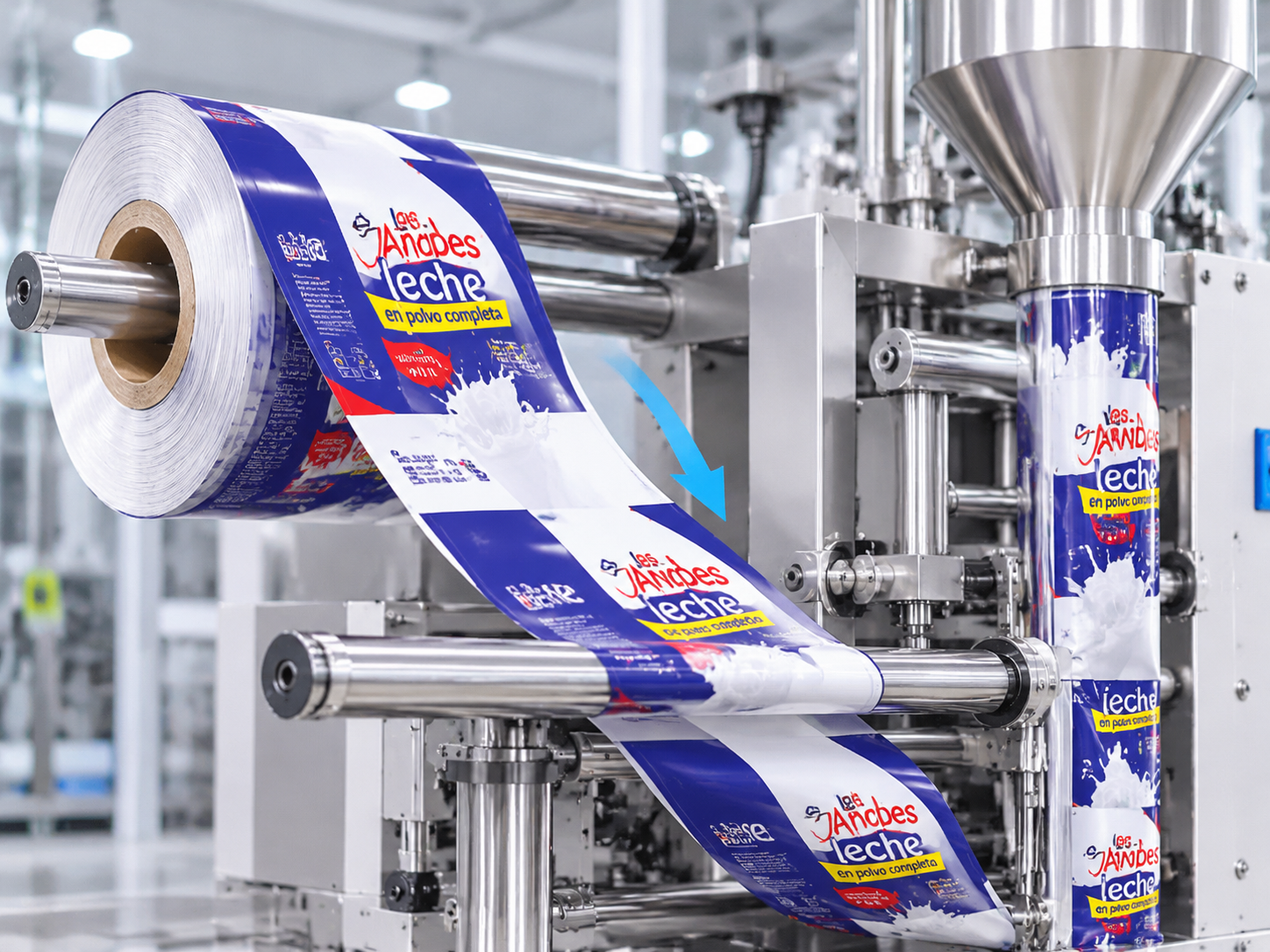
Before requesting a quotation, understand the technical requirements of your packaging equipment. Different VFFS (Vertical Form Fill Seal) and HFFS (Horizontal Form Fill Seal) machines may require different film dimensions, feeding directions, and sealing characteristics.
A roll of film that appears suitable based on its general specifications may still cause problems during actual production.
Before contacting a supplier, prepare the following information:
- Machine type and model
- Packaging speed and target output
- Maximum and minimum film width
- Maximum roll diameter
- Core inner diameter
- Film feeding and unwinding direction
- Sealing method and temperature range
- Eye-mark detection and registration requirements
Sharing these details helps the supplier understand your production requirements and recommend suitable automatic packaging film.
It also reduces unnecessary adjustments during sample testing and mass production.
2.Confirm the Correct Film Width
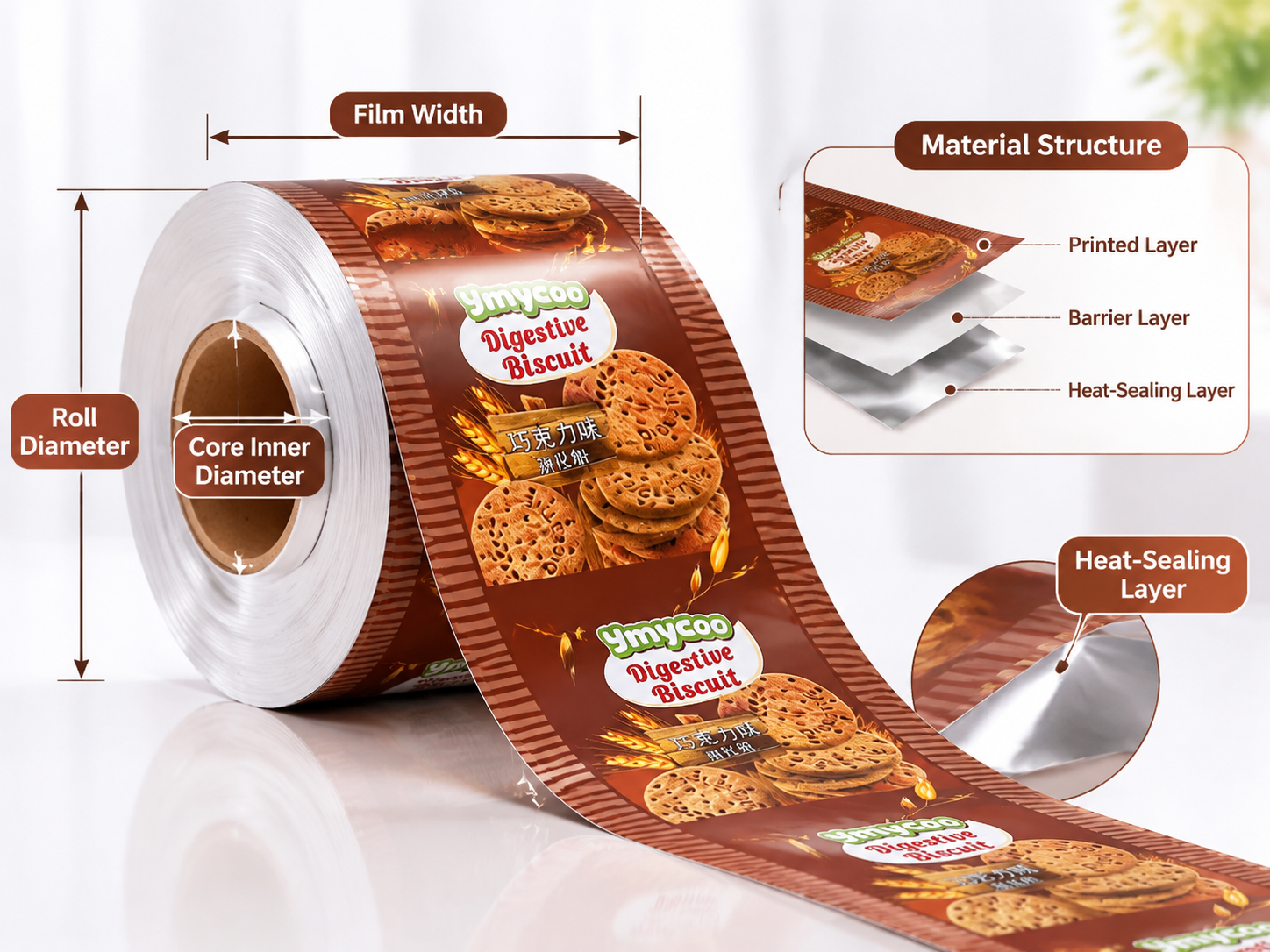
Film width is one of the most important specifications when sourcing custom printed rollstock film.
If the film is too wide, it may not fit the forming collar correctly or could create excessive material overlap. If it is too narrow, the machine may struggle to form the package properly, resulting in uneven side seals or incorrect bag dimensions.
To determine the correct width, consider:
- Finished bag width
- Side-seal or fin-seal allowance
- Forming collar dimensions
- Machine design and film-folding method
- Required sealing overlap
Do not calculate film width based only on the finished package dimensions. The forming structure and sealing allowances must also be considered.
For example, a food manufacturer producing pillow bags on a VFFS machine needs to confirm the relationship between the finished bag size, forming tube, and film width before ordering.
A packaging supplier experienced in automatic packaging applications can help review the dimensions and recommend suitable specifications.
3.Check Roll Diameter and Core Size
Roll diameter and core size directly affect whether the film can be installed and operated smoothly on the packaging machine.
Roll Diameter
The maximum roll diameter must be compatible with the machine’s film-loading space and unwinding system.
An oversized roll may not fit onto the machine, while a smaller roll may require more frequent changes, increasing operator workload and interrupting production.
For high-volume food processing facilities, larger rolls can reduce changeover frequency, but only when the equipment supports the required dimensions and weight.
Core Inner Diameter
The core inner diameter must match the machine’s film shaft or mounting system.
Common core sizes include 3-inch and 6-inch cores, but the correct choice depends on the equipment manufacturer’s requirements.
Before ordering, confirm:
- Core inner diameter
- Core material and strength
- Maximum roll weight
- Maximum roll diameter
- Shaft and chuck compatibility
A mismatch may cause installation difficulties, unstable unwinding, or film tension problems.
4.Confirm the Film Roll Winding Direction
Winding direction is another detail that should never be overlooked when sourcing printed packaging film.
Depending on the machine configuration, rollstock film may need to unwind in a specific direction, with the printed surface facing inward or outward.
If the winding direction is incorrect, the film may be installed improperly. The printed artwork, sealing layer, or eye marks may face the wrong direction, causing feeding errors and inaccurate package positioning.
Before production, confirm:
-Whether the film unwinds clockwise or counterclockwise
-Whether the printed side faces inward or outward
-Which side carries the heat-sealing layer
-Whether the roll requires a specific winding configuration
-The required orientation of the eye mark
Providing a reference drawing or sample roll can help the supplier understand the correct unwinding direction.
For large-volume orders, these requirements should be included in the approved packaging specifications rather than confirmed only through verbal communication.
5.Select the Right Material Structure and Heat-Sealing Layer
The material structure determines the protective performance, mechanical strength, and sealing characteristics of rollstock film.
Food products have different packaging requirements. Coffee, frozen food, snacks, dried fruit, and powdered products may require different barrier properties and sealing performance.
Common flexible packaging structures include:
| Material Structure | Typical Application |
| PET/PE | General food packaging and moisture protection |
| BOPP/CPP | Snack packaging and dry food products |
| PET/VMPET/PE | Products requiring improved light and moisture barriers |
| PET/AL/PE | High-barrier applications requiring strong protection |
The final structure should be selected according to the product’s sensitivity, shelf-life requirements, filling conditions, and packaging machine.
Why the Heat-Sealing Layer Matters
The inner sealing layer directly affects how the film performs during automatic packaging.
Important factors include:
- Heat-sealing temperature
- Sealing pressure
- Dwell time
- Hot tack strength
- Seal integrity
- Compatibility with the filling process
If the sealing layer is unsuitable, the machine may experience weak seals, leakage, or inconsistent sealing results.
For example, products containing oil or powder may contaminate the sealing area during filling. In this situation, the material must provide suitable sealing performance under the actual operating conditions.
Procurement managers should request technical data and, whenever possible, conduct sealing tests using the actual machine before approving large-volume production.
6.Make Sure the Printing Position Matches the Machine
Printing accuracy is not just about visual appearance. It also determines whether the machine can correctly detect and position the packaging artwork.
For printed rollstock film, the artwork must be designed around the actual bag dimensions and machine registration system.
Key printing details include:
-Eye Mark Position: Most automatic packaging machines use printed registration marks to identify where each package should be cut. The eye mark must be positioned correctly for the machine’s photoelectric sensor.
-Repeat Length: The printing repeat length should match the required package length and machine feeding cycle.
-Print Orientation: Text, logos, graphics, and other design elements must face the correct direction after the film is formed into a bag.
-Sealing Area: Important artwork should not overlap with sealing zones, cutting positions, or areas that may be folded during forming.
-Print Tolerance: The supplier should confirm the acceptable registration tolerance to avoid artwork shifting during production.
Before printing begins, the packaging supplier and buyer should review the artwork, dieline, eye-mark position, and repeat dimensions together.
Working with an experienced printed packaging film manufacturer can help reduce printing errors and improve compatibility with automatic packaging systems.
7. Confirm Machine Parameters Before Mass Production
Even when the film dimensions and material structure are correct, production problems may still occur if the packaging machine parameters are not properly adjusted.
A successful packaging project requires coordination between the film specifications and machine operating conditions.
The following parameters should be checked:
| Machine Parameter | What to Confirm |
| Film tension | Stable unwinding without stretching or wrinkles |
| Pulling speed | Compatible with film feeding performance |
| Sealing temperature | Suitable for the inner sealing layer |
| Sealing pressure | Sufficient for consistent seal formation |
| Dwell time | Enough time to create a reliable seal |
| Cutting position | Accurate alignment with the printed repeat |
| Eye-mark sensitivity | Reliable detection during continuous operation |
One important point is that increasing machine speed does not automatically improve productivity. If the film cannot maintain stable feeding and sealing at the target speed, the line may experience more interruptions and defective packages.
Therefore, the film should be tested under realistic production conditions rather than evaluated only through laboratory specifications.
8. Case Study: Solving Film Compatibility Problems for a Food Processing Plant
A food processing customer operating an automated packaging line experienced recurring production problems after purchasing printed rollstock film.
Although the film appeared suitable based on its general material specifications, actual production performance was inconsistent.
Main Problems
During continuous operation, the packaging team identified several issues:
-Film width did not provide suitable forming and sealing allowances.
-Roll dimensions were not fully compatible with the machine.
-Printed eye marks were incorrectly positioned for the registration sensor.
-The heat-sealing layer required additional parameter adjustments.
As a result, operators frequently stopped the production line to adjust film feeding and machine settings. This increased material waste and reduced production efficiency.
Our Solution
Our team worked with the customer’s technical staff to review the complete packaging process.
The project focused on five areas:
1.Film dimensions: Confirmed film width, roll diameter, and core size against equipment specifications.
2.Winding direction: Standardized unwinding direction and printed-side orientation.
3.Material selection: Reviewed barrier performance and selected a suitable inner heat-sealing layer.
4.Printing adjustment: Optimized eye-mark position, repeat length, and artwork orientation.
5.Machine testing: Conducted production trials and coordinated film tension, sealing temperature, pressure, and dwell time.
Project Results
After coordinating film specifications with machine parameters, the customer achieved more stable film feeding, improved registration accuracy, and more consistent sealing performance.
The project also established standardized specifications for future rollstock film orders, reducing the risk of repeated compatibility problems.
This case demonstrates that high-speed packaging efficiency depends on the complete match between packaging materials, printing design, and machine configuration.
9. How to Choose a Reliable Rollstock Film Supplier
Choosing the right supplier is just as important as selecting the right material.
For large food manufacturers and automated packaging companies, a reliable supplier should provide more than printing and film production services.
Look for a printed packaging film manufacturer that can support:
-Customized material structures for different food applications
-Accurate film width, roll diameter, and core specifications
-Professional printing and eye-mark positioning
-Suitable heat-sealing materials
-Technical communication about packaging equipment
-Sample testing and production support
-Consistent quality control for repeat orders
When requesting a quotation, provide your machine model, product type, target bag dimensions, and expected production speed.
The more accurate the initial information, the easier it is for the supplier to recommend a suitable custom rollstock film solution.
10.Conclusion: Better Packaging Efficiency Starts with the Right Film Specifications
Choosing the right custom rollstock film helps improve packaging efficiency, reduce material waste, and ensure stable machine performance.
HUIYANG PACKAGING provides customized flexible packaging solutions, including printed packaging film, food packaging rollstock film, stand-up pouches, zipper pouches, and spout pouches.
Share your machine specifications, material requirements, film dimensions, and artwork with our team for a technical review before production.
Frequently Asked Questions (FAQs)
1. What information should I provide when ordering custom rollstock film?
Provide the packaging machine model, film width, maximum roll diameter, core inner diameter, winding direction, material structure, bag dimensions, printing requirements, and sealing specifications.
2. How do I know whether rollstock film is compatible with my packaging machine?
Check film dimensions, unwinding direction, material properties, sealing performance, and printing registration. Consult your supplier and conduct a machine trial before bulk production.
3. Why does rollstock film wrinkle or feed unevenly?
Common causes include incorrect film width, unstable tension, unsuitable material thickness, incorrect winding direction, and poor machine alignment.
4. Can custom rollstock film be used for different food products?
Yes. It can be customized for snacks, coffee, frozen food, dried fruit, powdered products, and other food applications. Material structures and barrier properties should match each product’s requirements.
5. Why should I test rollstock film before placing a large order?
A production trial verifies feeding, forming, printing registration, sealing, and cutting performance under actual operating conditions. It helps reduce material waste and unexpected downtime.
Post time: Nov-11-2026