


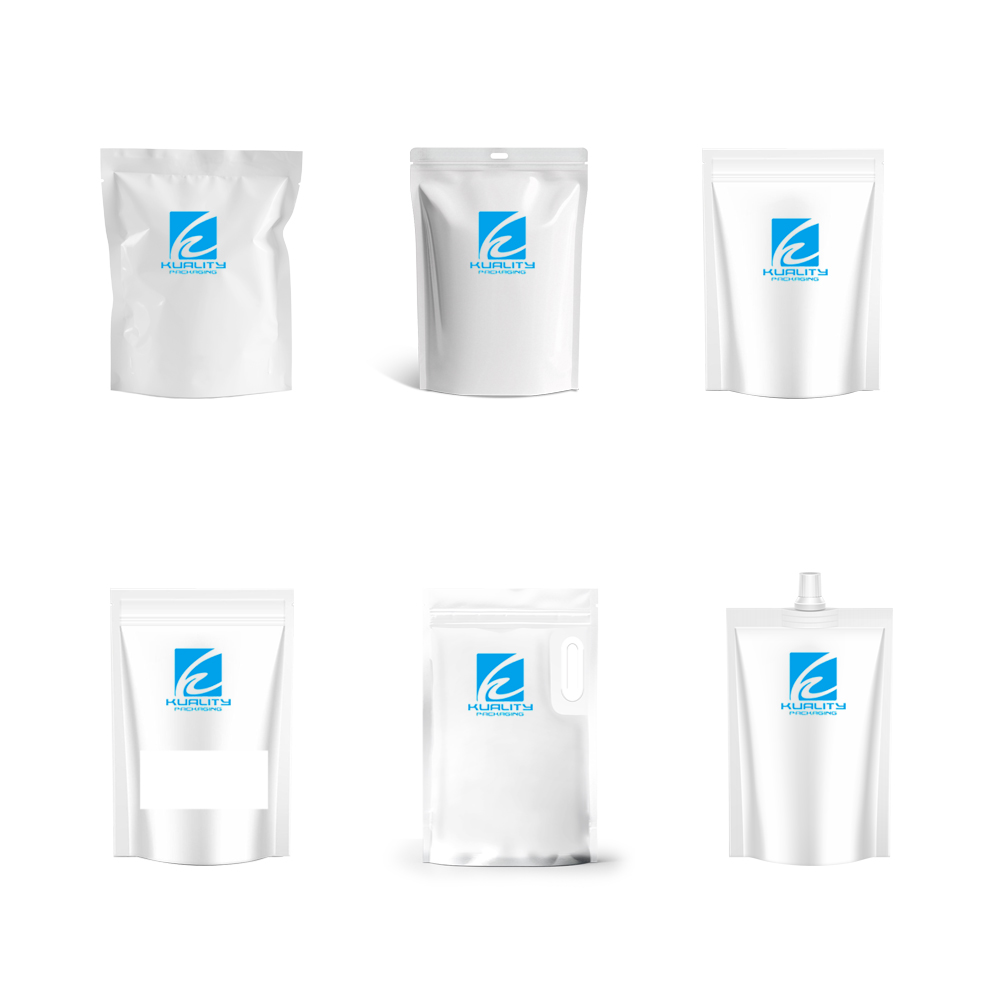
1. What is a stand-up bag?
A: A stand-up bag is a flexible packaging bag with a special structure at the bottom, which allows it to “stand up” on the shelf without additional support. It combines the flexibility of traditional plastic bags with the display of paper boxes, and is very suitable for liquid, powder, and granular products (such as beverages, sauces, pet food, snacks, daily chemicals, etc.). It is a cost-effective and efficient form of flexible packaging.
2. Why choose customized self-supporting packaging bags?
Answer: The advantages of customized self-supporting packaging bags include:
Excellent shelf display: standing display attracts attention, enhances brand image and product visibility.
Space saving: more compact during transportation and warehousing, saving costs.
Flexible design: customizable shape, size, material, printing effect (UV matte oil, hot stamping (also divided into cold stamping, hot stamping), washed aluminum, laser transfer, UV anti-counterfeiting, temperature-changing ink, etc.), perfectly matching the brand tone.
Functionality: can be equipped with various zippers (easy to tear, resealable), nozzles, handles, etc. to improve the convenience of use.
Diverse material selection: suitable composite film structure can be selected according to product characteristics (such as barrier properties, freshness preservation, puncture resistance, high temperature sterilization resistance).
Environmental protection trend: recyclable, degradable or environmentally friendly materials containing recycled materials (PCR) can be selected.
3. What is the basic process of customizing self-supporting packaging bags?
Answer: The typical process is as follows:
1. Demand communication: determine product characteristics, size, target market, budget, expected quantity, design concept, functional requirements (such as whether zipper/nozzle/air valve is required), etc.
2. Design draft confirmation: provide your design file (AI/PDF/CDR/PSD format), our designers will check the file specifications (size, resolution, bleed position, color mode CMYK, etc.), and may provide design suggestions or proofing draft confirmation for some parts involving printing.
3. Material selection and confirmation: According to product requirements and design effects, jointly determine the appropriate combination of materials such as surface layer, barrier layer, heat sealing layer, etc.
4. Sample production and confirmation: The supplier produces physical samples for your review (material, printing effect, size, structure, function, etc.).
5. Production: After the sample is confirmed to be correct, arrange mass production.
6. Quality inspection and delivery: Quality inspection is carried out after production is completed, and packaging and delivery are carried out after passing the inspection.
4. What is the minimum order quantity?
A: The minimum order quantity (MOQ) varies by supplier, bag complexity, material, and printing process (especially spot colors or special processes). It usually ranges from 50,000 pieces or more. Simpler bags and standard processes may have lower MOQs, while complex designs, special materials or processes require higher MOQs to share the plate making and startup costs. Please communicate with us for confirmation.
5. How long does the custom production cycle take?
A: The production cycle is affected by factors such as order volume, design complexity, material stocking, and sample confirmation speed. Generally speaking:
Sample stage: After receiving the confirmed design draft and material requirements, it usually takes 7-15 working days to provide samples.
Mass production: After sample confirmation, mass production usually takes 15-30 working days. Peak season or complex orders may take longer.
6. How is the price calculated?
Answer: The price of custom stand-up bags is mainly determined by the following factors:
Material cost: the type of film used (PET/AL/NY/PE, etc.), thickness, layer structure, whether it is a special/environmentally friendly material.
Size: The larger the bag, the more material is used and the higher the cost.
Printing process: the number of printing surfaces (single-sided/double-sided), the number of colors (spot colors are usually more expensive than four-color CMYK), whether special processes are required (such as local UV, hot stamping, laser, embossing effects).
Bag type complexity: standard stand-up bags, stand-up bags with zippers, stand-up bags with nozzles, special-shaped stand-up bags, etc. The more complex the structure, the higher the difficulty and cost of bag making.
Functional accessories: the type and cost of zippers, nozzles, handles, etc.
Order quantity: the larger the quantity, the lower the unit cost (sharing fixed costs).
Plate fee: the cost of the printing plate required for printing (usually charged by color, a one-time fee, and amortized into the order).
Shipping cost: depends on the quantity and destination.
7. What are the common material choices? How to choose the right material?
Answer: Examples of common composite material structures:
Basic barrier type: PET/PE, OPP/PE (economical, suitable for dry products)
Medium barrier type: PET/VMPET/PE (increased light and oxygen barrier), PET/AL/PE (high barrier, suitable for oil and oxidizable products)
High barrier type: PET/AL/NY/PE, PET/NY/AL/PE (puncture-resistant, high barrier, suitable for products with angular contents and long shelf life)
Transparent high barrier type: PET/NY/EVOH/PE (transparent high barrier, suitable for products that display contents and need to be kept fresh)
Degradable/environmentally friendly: PLA/PLA, PLA/PBAT, composite materials containing PCR recycled materials.
Cooking type: PET/NY/RCPP (resistant to high temperature cooking and sterilization).
Selection basis: Mainly consider product characteristics (whether it needs to be oxygen-proof, moisture-proof, light-proof, oil-resistant, acid-resistant, alkali-resistant, and high-temperature-resistant), shelf life requirements, content form (whether it has sharp edges and corners), whether it needs transparent display, environmental protection requirements, and cost budget. The supplier will recommend a suitable material combination based on your needs.
8. Can the printing effect meet my design expectations?
A: High-quality suppliers use advanced gravure or high-precision digital printing machines to achieve very fine printing effects, close to your design draft. The key is:
The design files you provide must meet the printing specifications (clear images, high resolution, correct bleeding, CMYK mode, correct size) confirm your color requirements (providing Pantone color numbers will have better results) and special effect requirements (such as printing gold ink or silver ink, local UV).
Be sure to confirm the physical samples before mass production (samples can be sent for reference color) or we can provide paper drafts for reference! This is a key step to ensure that the final printing effect meets expectations.
9. What functional accessories can be added?
Answer: Common functional accessories include:
Zipper: Provides convenient opening and reclosing functions to keep the contents fresh. There are many types such as ordinary, press-to-close, and slider.
Spout: Convenient for pouring liquids or viscous products, usually equipped with a lid.
Handle: Convenient for consumers to carry, especially suitable for bags with larger capacity.
Degassing Valve: Mainly used for products such as coffee beans that produce gas after roasting, exhaust gas to prevent bag bulging, and block external air from entering.
Tear Notch: Convenient for consumers to open the package easily.
10. How to ensure the quality of packaging bags?
Answer: Reliable suppliers will:
Use raw materials that meet food grade or relevant industry standards.
Perform key performance tests on finished products, such as:
Seal strength test: Ensure that the sealed edge is firm and not easy to leak.
Heat seal strength test: Ensure that the material has good heat sealing performance.
Friction coefficient test: Ensure that the bag is not easy to slip during transportation and stacking.
Barrier performance test: If necessary (oxygen permeability, water vapor permeability).
Drop test: Simulate the ability to resist falling during transportation and use.
Load test: Test the load-bearing capacity of the bottom of the self-supporting bag.
Provide a quality inspection report (COA).
11. What should be paid attention to during transportation and storage of packaging bags?
A: To ensure that the bags are in good condition when they arrive at the filling plant or in your hands:
Avoid heavy pressure: The number of stacking layers should not be too high to prevent the bags from deforming or the seals from being compressed.
Avoid puncture by sharp objects: Be careful when transporting and handling.
Maintain a suitable environment: Store in a cool, dry, clean environment, avoid direct sunlight and extreme temperatures.
Moisture-proof: Especially for materials that are easy to absorb moisture (such as NY nylon).
We usually pack properly (such as using cartons + stretch film) to protect the bags.
12. Do you offer environmentally friendly material options?
A: Yes, we attach great importance to sustainable development and provide a variety of environmentally friendly material solutions for you to choose from, such as:
Recyclable material design: Use a single material structure (such as PP or PE) or a combination of materials compatible with recycling streams to increase recycling rates.
Post-consumer recycled plastics: Use films containing a certain proportion of PCR (post-consumer recycled resin).
Degradable/compostable materials: Films made of bio-based or compostable materials such as PLA (polylactic acid) and PBAT (must clearly meet the standards, such as industrial composting/home composting).
Reduce material usage: Optimize the design and use thinner films while ensuring performance. Please let us know your specific environmental goals and we will recommend the most suitable solution for you.
13. How to place an order or get a quote?
A: Please contact us via the following methods:
WhatsApp: [+8613433772669]
Email: [even@huiyangpackaging.com]
Website: [www.hyflexpack.com]
Please provide your requirements as detailed as possible (refer to question 3), and we will provide you with professional advice and accurate quotes as soon as possible.
Post time: Jul-12-2025